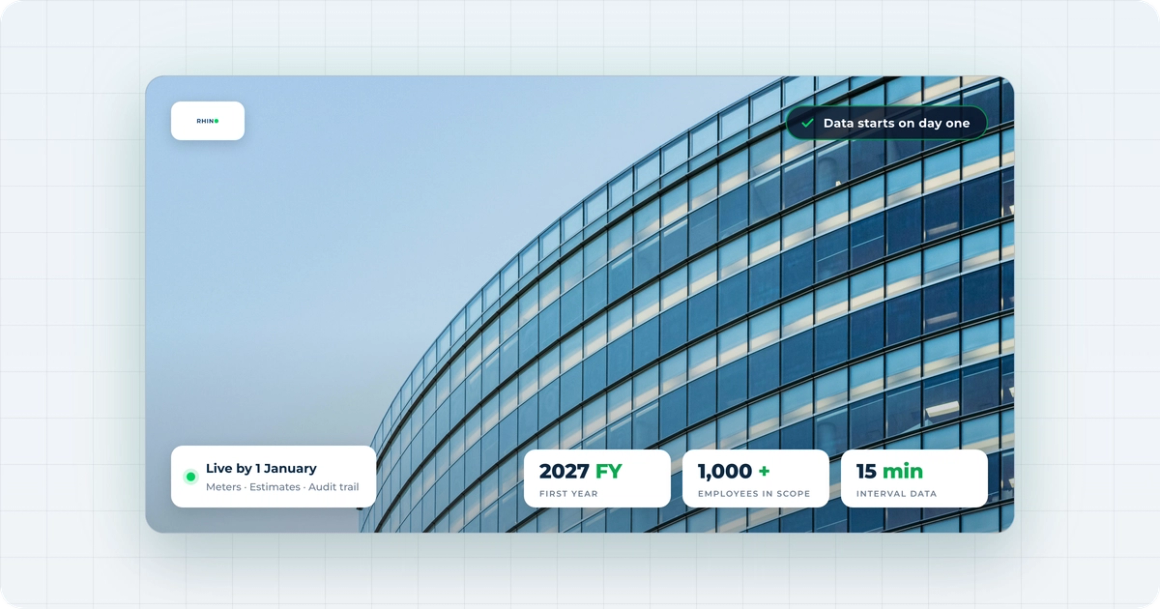
For a company newly in scope of the Corporate Sustainability Reporting Directive (CSRD), the first CSRD reporting year is financial year 2027. The report is due in 2028, but the energy data in it starts on 1 January 2027. Meter readings that are not recorded in January cannot be recorded in 2028.
Many sustainability teams read the Omnibus I simplification package as a reason to wait. This post explains who is still in scope after Omnibus I, which energy data the European Sustainability Reporting Standards (ESRS) ask for, why that data cannot be collected after the fact, and what to do between October and December 2026 so it exists from day one.
What is the first CSRD reporting year after Omnibus I?
The first CSRD reporting year is the first financial year a company must cover in its sustainability statement. For EU companies that were not already reporting, Omnibus I sets it at financial year 2027, with the first report published in 2028. A company with a calendar financial year therefore starts collecting reportable data on 1 January 2027. Every month of that year ends up in the first report.
How did Omnibus I change CSRD timing and scope?
Omnibus I moved the start date for "wave 2" companies by two years and cut the number of companies in scope. It happened in two steps.
The first step was the stop-the-clock Directive (EU) 2025/794, adopted on 14 April 2025. It postponed reporting for companies that were due to start with financial year 2025 or 2026, as the European Commission's CSRD page summarizes.
The second step was the content package itself. The Council gave its final approval on 24 February 2026, and it was published as Directive (EU) 2026/470 on 26 February 2026. It entered into force on 18 March 2026. Member States have until 19 March 2027 to write it into national law. Our overview of upcoming ESG reporting deadlines covers the full timeline across CSRD, ESRS, the EU Taxonomy and the due diligence directive.
Who is still in scope of CSRD after Omnibus I?
An EU company is in scope only if it has more than 1,000 employees and more than €450 million in net turnover. It must exceed both thresholds, at company or group level. Everyone else is out of mandatory CSRD reporting.
| Which company is it? | Is it in scope after Omnibus I? | What is its first reporting year? |
|---|---|---|
| An EU company that already reported for financial year 2024 and still exceeds both thresholds. | It stays in scope and keeps reporting. | It has already started, and financial year 2027 is its first year under the revised ESRS. |
| An EU company that already reported for financial year 2024 but falls below either threshold. | It falls out of scope, and a transition exemption covers financial years 2025 and 2026. | It has no mandatory first year under the new rules. |
| An EU company that was not yet reporting and exceeds both thresholds. | It is newly in scope. | Its first reporting year is financial year 2027, with the report due in 2028. |
| An EU company with 1,000 employees or fewer, or €450 million turnover or less. | It is out of mandatory scope. | It has no first reporting year, although large customers and investors can still ask for data. |
Being out of scope is not the same as never being asked. Directive (EU) 2026/470 limits what in-scope companies can request from value chain companies with fewer than 1,000 employees, but investors still ask. The Omnibus Paradox explains why investor data requests have not shrunk with the regulation.
Which energy data does ESRS E1 require?
ESRS E1 (Climate change) requires total energy consumption from own operations in megawatt hours (MWh), split into fossil, nuclear and renewable sources. The disclosure is called "Energy consumption and mix". It was E1-5 in the 2023 standards and is E1-7 in the revised ESRS E1 drafted by the European Financial Reporting Advisory Group (EFRAG).
The revised ESRS were adopted by the Commission on 3 July 2026 and apply to financial years beginning on or after 1 January 2027, according to EFRAG. The delegated act is with the European Parliament and the Council for scrutiny. Wave 2 companies will report their first year under the revised version.
Three details matter for property owners. The disclosure applies when climate change is material in the company's double materiality assessment. Renewable electricity only counts as renewable under the market-based approach when a contract or a guarantee of origin backs it. And the standards allow estimates, but ESRS 1 requires the company to disclose whether a figure relies on estimates, plus the significant assumptions and limitations behind them.
Does the first CSRD report need assurance?
Yes. The CSRD requires a limited assurance opinion on the sustainability statement from the first report, as set out in Directive (EU) 2022/2464. Limited assurance means an auditor or independent assurance provider tests the reported figures and the process behind them. For energy, that means tracing a MWh total back to meters, readings and estimation rules.
Why can't 2027 energy data be collected later?
Interval data that was never recorded cannot be recreated. A submeter on a pulse output, a building management system (BMS) that overwrites its logs, or a meter nobody read in February leaves a gap that no tool can fill in 2028. The only option then is an estimate, and every estimate has to be disclosed and defended.
There is an honest limit to this argument. The annual MWh total that ESRS E1 asks for can, in principle, be assembled from supplier invoices, and grid operators often keep history for main smart meters. If a portfolio only has main meters on a single supplier contract, a manual invoice pull may get close.
Most portfolios are not that simple. Invoices arrive late, some carry estimated readings, and they do not show which building, which tenant area or which submeter used the energy. Submetered tenant consumption is not on a supplier invoice at all. When the assurance provider asks how a number was built, an invoice pile is a weak answer.
What has to be live on 1 January 2027?
Three things need to be in place before the reporting year opens: meter coverage, a known estimation share, and an audit trail.
Meter coverage. Every meter that feeds the energy number is identified and read automatically, including gas, heat and the submeters that split consumption between owner and tenants.
The estimation share. You know, per meter and per month, which values are measured and which are estimated, and the estimation method is written down before the first gap appears.
The audit trail. Each reported MWh can be traced to a meter serial number, a location, a data source and a timestamp. Manual corrections are recorded, not overwritten.
What should you do between October and December 2026?
About eleven weeks is enough to get the basics live if the work starts now. The checklist below runs in the order the dependencies allow.
| When should it happen? | What should be done? | Why does it matter on 1 January 2027? |
|---|---|---|
| Early October | List every meter that feeds energy consumption, per building and per utility, including submeters and heat. | You cannot collect data from a meter that is not on the list. |
| October | Check which meters can be read remotely, for example with the meter compatibility check. | Meters that need a visit or new hardware take the longest, so they go first. |
| November | Connect remote readings and confirm that 15-minute data arrives for each meter. | A connection tested in November is one less gap in January. |
| November | Write down the estimation method and agree how estimated values are flagged. | ESRS 1 asks you to disclose estimates and their assumptions, so the rule has to exist before the first estimate. |
| November | Collect the electricity contracts and guarantees of origin for every site. | Under the market-based approach, renewable electricity only counts as renewable when a contractual instrument backs it. |
| December | Build a meter register with serial number, location, building, utility and data source. | The register is the first thing an assurance provider asks to see. |
| December | Run a dry run: produce a December MWh total split by fossil, nuclear and renewable, and walk it through with your assurance provider. | A problem found in December can still be fixed. A problem found in 2028 can only be disclosed. |
How does Rhino help with CSRD energy data?
Rhino is the data layer between your meters and your reporting stack. It collects electricity, gas, water and heat data, including submeters, through software-only smart meter connections, utility provider connectors, existing building systems such as a BMS, or Rhino's own hardware where nothing else fits.
Data arrives at 15-minute granularity from the day a meter is connected. Each meter carries its serial number, location, group and tenant, and whether its values are automatic or manual, in one register. Rhino is not an ESG reporting platform. It feeds the platforms that produce the report, such as Deepki.
Rhino does not decide your materiality, your estimation method or your renewable split. And it cannot recover 2027 data that was never recorded: a meter connected in March starts in March. That is the whole case for connecting in the fourth quarter of 2026.
Frequently asked questions
When is the first CSRD reporting year for wave 2 companies?
The first CSRD reporting year for EU companies newly in scope after Omnibus I is financial year 2027, with the first report published in 2028. For a calendar financial year, data collection starts on 1 January 2027. The stop-the-clock Directive (EU) 2025/794 moved this start by two years, and Directive (EU) 2026/470 confirmed the reduced scope.
Is my company still in scope of CSRD after Omnibus?
An EU company is in scope of CSRD after Omnibus I only if it has more than 1,000 employees and more than €450 million in net turnover. Both thresholds must be exceeded. Companies below either threshold are out of mandatory reporting, although investors and large customers can still request energy and emissions data from them.
Can you use estimated energy data in a CSRD report?
Yes, estimated energy data is allowed in a CSRD report, but it has to be disclosed. ESRS 1 requires companies to state whether figures rely on estimates and to explain the significant assumptions and limitations behind them. Because the first report needs limited assurance, every estimate also needs a documented method an assurance provider can test.
Which energy data does ESRS E1 require?
ESRS E1 requires total energy consumption from own operations in megawatt hours (MWh), split into fossil, nuclear and renewable sources. In the revised ESRS this disclosure is E1-7, Energy consumption and mix, previously E1-5. It applies when climate change is material, and under the market-based approach renewable electricity counts only when a contract or guarantee of origin backs it.
If your first CSRD reporting year is 2027, the meters, the estimation rules and the audit trail all have to be running on 1 January. See how Rhino delivers audit-ready energy data for CSRD.