

Solar monitoring
Find the kWh you never had to buy.
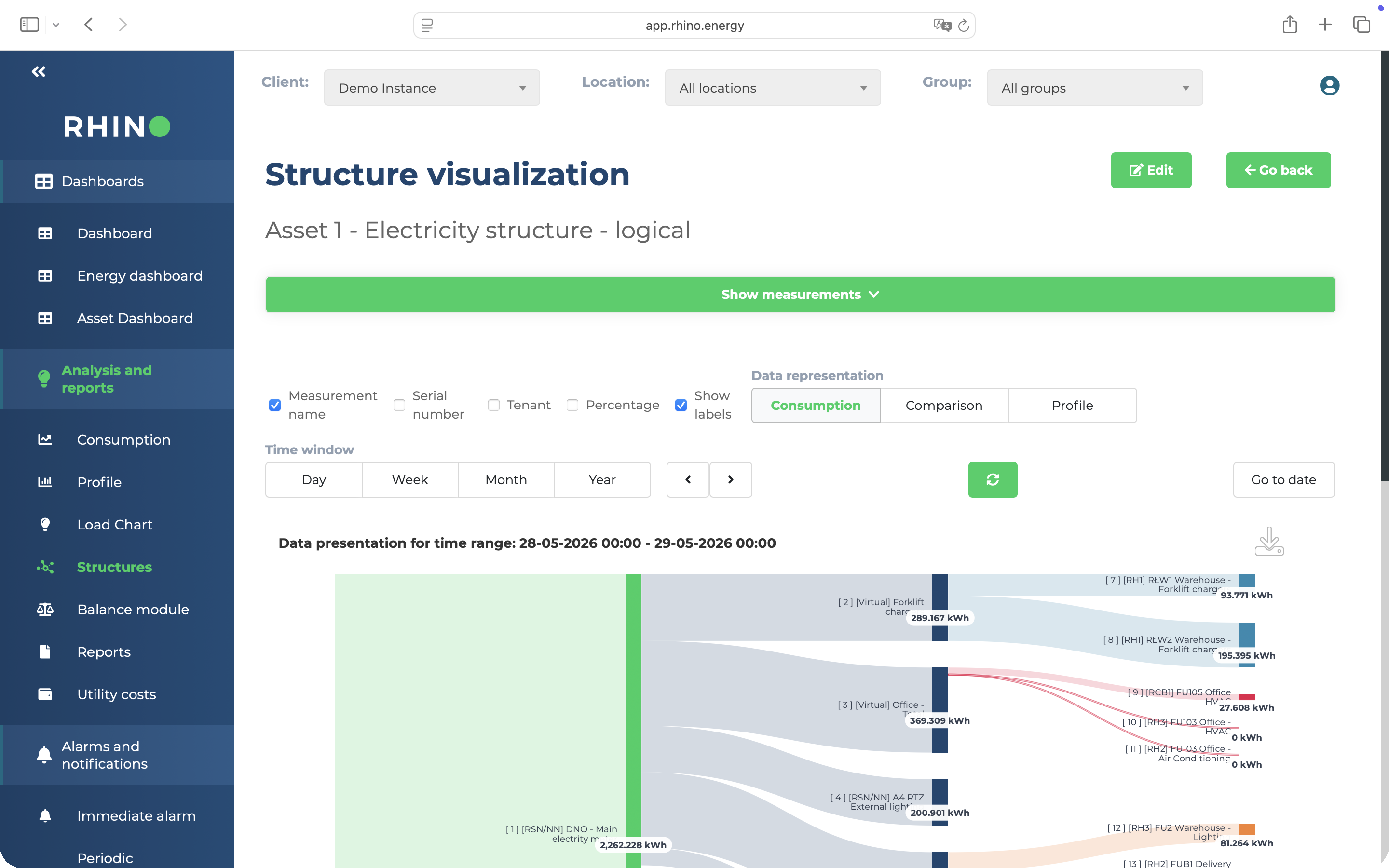
Rhino reads your solar generation on the same meter tree as your consumption: generation meters, inverters, and the grid connection. Generated, self-consumed, exported, imported, all at 15-minute intervals. A net meter hides three of those four numbers.
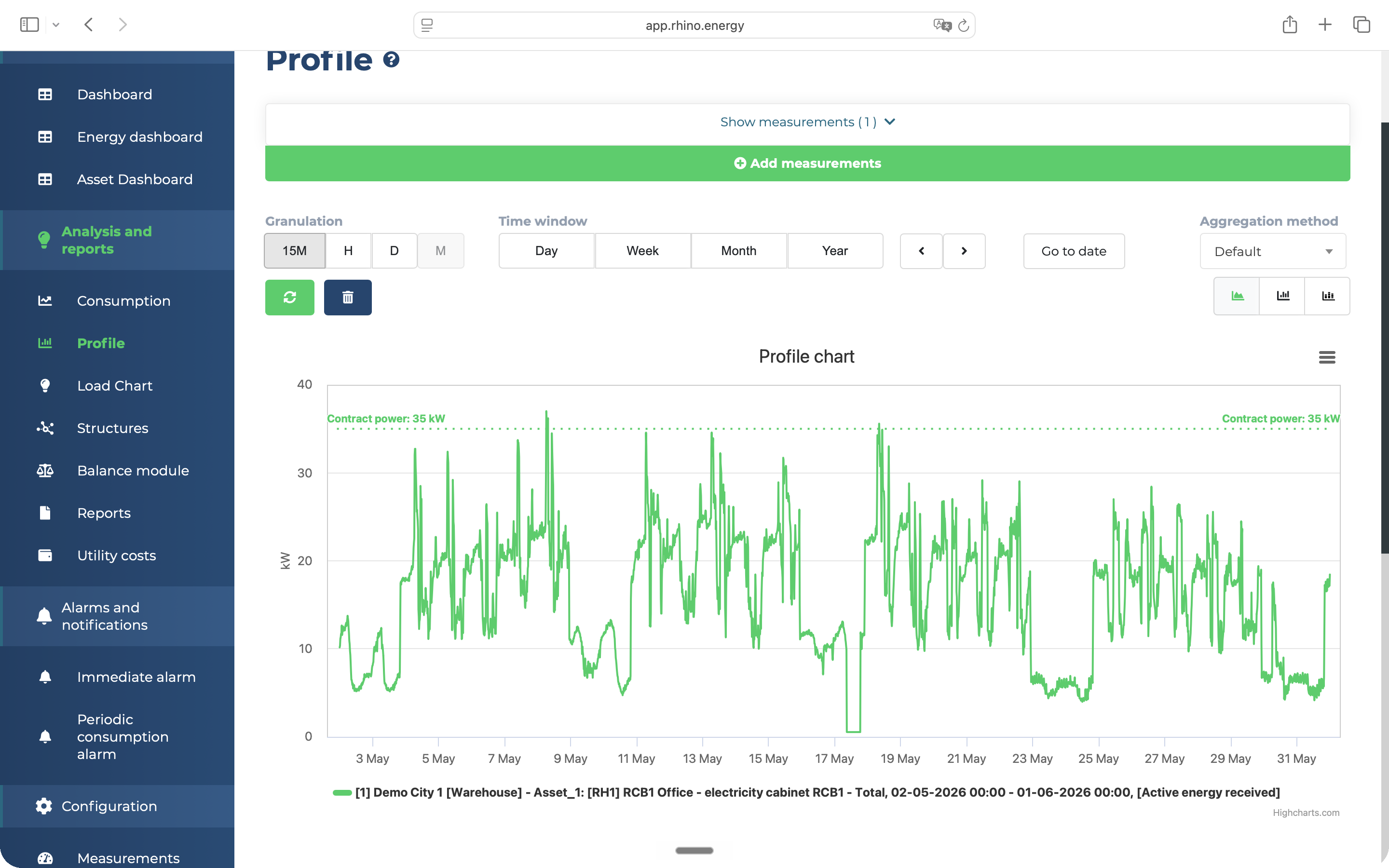
15 min
Generation and consumption on the same interval
4 figures
Generated, self-consumed, exported, imported
−30%
Average energy cost savings
40+ countries
Active worldwide
What you see
Four numbers, not one.
A net meter reports import minus export and stops there. Meter the generation too and the building's real position appears: what the array made, what the building used, what went to the grid, what you still had to buy.
Generation
What the array actually produced.
Generation in kWh at 15-minute intervals, per array and per building, with specific yield in kWh/kWp so a 400 kWp roof in Rotterdam can be compared to a 900 kWp roof in Wroclaw. Measured at the meter, not read off a manufacturer portal.
Explore the dashboardSelf-consumption
The share your building used itself.
Self-consumption is the part of generation the building consumed rather than exported. Self-sufficiency is the part of demand your own generation covered. Two different numbers, and reporting one without the other tells you nothing. Rhino computes both from interval data.
See how the platform worksExport and import
Both directions at the grid connection.
Feed-in and grid import recorded separately, per site, at the same interval. Gross import is what your emissions factor applies to. It is also the number an ESG auditor asks for when the utility invoice shows only the net position.
See ESG reportingAlarms
A dead string looks like weather until you compare.
A failed string drops yield by a fixed fraction and keeps running that way for months, because nobody logs into the portal and the bill only shows the net. Set a threshold per meter and Rhino sends the site, the value, and the timestamp when yield falls out of pattern.
See how alarms workUtility Connectors
Cloud-to-cloud reads from smart meter networks and utility providers across Europe and North America. No hardware on site.
Rhino Hardware
Small, non-intrusive devices for meters that software can't reach. No rewiring, no downtime, low CAPEX. EU and US certified.
Third Party Infrastructure
Connect via an existing BMS, IoT gateway, or Modbus setup. Adds Rhino to what's already installed. No CAPEX, no replacement required.
What it gives you
A rooftop is an asset. Treat it like one.
Three things portfolios do with metered generation data from day one.
ESG reporting
Renewable energy you can evidence.
Self-consumed solar is not purchased electricity, so it carries no Scope 2 emissions. It also does not reduce your reported energy consumption: CSRD and the GHG Protocol both require gross grid import rather than a net figure. GRESB goes further and asks for actual, non-estimated data. Rhino supplies the measured numbers behind all three.
See ESG reportingInvoice verification
Check the PPA invoice against your own meter.
Under a rooftop PPA or roof lease you pay per kWh delivered, and the quantity on the invoice usually comes from the operator's own equipment. An MID-certified meter at the connection point gives you an independent reading of the same kWh. The party being paid should not be the only party counting.
See billing and allocationGrid capacity
Where export is queued, self-consumption is the lever.
In the Netherlands alone, 8,539 requests for feed-in capacity were on grid operator waiting lists in October 2025, together 4,591 MW. Every kWh moved from export to self-consumption needs no feed-in capacity and no place in that queue. Sizing a battery or shifting a load needs the interval surplus profile, not an annual total.
See grid headroom analysis
How it connects
Three ways to read a rooftop.
Which one fits depends on what is already installed and who owns the array.
Generation meter
A meter on the AC side of the inverter.
The most defensible route. A generation meter measures what reached the building, after cabling and transformer losses, and it is a separate instrument from the thing whose output it checks. Any MID-certified meter with Modbus, M-Bus, or a pulse output connects to the Rhino AP.
Inverter
Straight off the inverter's Modbus interface.
Most commercial inverters expose generation data over Modbus RTU or Modbus TCP, which is the same interface the Rhino AP already speaks. Enphase, SolarEdge, Solis, and Growatt are among the brands on Rhino's hardware page. An inverter not on a list is not an inverter we can't read: it is a conversation.
Existing systems
Through the BMS or gateway already on site.
Where PV output is already landing in a building management system, an IoT gateway, or a monitoring platform, Rhino connects to that instead of adding hardware. Generation then sits in the same meter tree as everything else, which is the point: self-consumption cannot be calculated across two systems with two clocks.
Where the data goes
Your ESG platform needs both halves.
Give a reporting platform a net figure and it reports a building that uses less energy than it does. Rhino sends generation and consumption as separate series, over the same API, so the platform can work out the renewable share instead of estimating it.
Common questions
Solar monitoring, answered.
Yes. Solar generation is read as another measurement point on the same meter tree as electricity, gas, water, and heat, so generation and consumption arrive at matching 15-minute intervals in one platform. That matters more than it sounds: self-consumption can only be calculated when both series share an interval and a clock. Generation held in a separate manufacturer portal cannot be combined with consumption held somewhere else.
Self-consumption is the share of what you generated that the building used rather than exported. Self-sufficiency, sometimes called the autarky rate, is the share of what the building needed that your own generation covered. Same kWh on top, different denominator underneath. They also move in opposite directions: a small array on a busy building shows near-total self-consumption and very little self-sufficiency, which is why a high self-consumption figure on its own is often evidence of an undersized roof rather than a well-run one. Rhino reports both.
Both routes work. Most commercial inverters expose generation over Modbus RTU or Modbus TCP, and that is the interface the Rhino AP already speaks. A separate generation meter on the AC side is the stronger option where the number carries money or a disclosure behind it: it measures what actually reached the building rather than what the inverter believes it sent, it can be MID-certified, and it keeps recording when the inverter's own connection drops. Where an array is already reporting into a BMS or gateway, Rhino can take the data from there instead.
Solar you generate and consume on site is not purchased electricity, so it carries no Scope 2 emissions under the GHG Protocol. It does not reduce your reported energy consumption either: both the GHG Protocol and ESRS require gross grid import, not import netted against export, and energy sold to a third party does not come off your own consumption figure. ESRS also asks for renewable energy production separately, in MWh. GRESB reports on-site generation and the part of it consumed on site, split by whether landlord or tenant controls it, and expects actual rather than estimated data. All of that needs generation metered, not inferred.
Usually not as your own renewable generation. GRESB's position is that a landlord who leases out the roof and has no control over the energy generated is not reporting entity for that generation. Many rooftop PPAs also assign the certificates to the operator, which is what carries the emissions claim. What metering does give you is the part you can still act on: an independent count of the kWh you are invoiced for, the share of it your building actually consumed, and a defensible gross import figure for the reporting you do own. Where the contract needs revisiting, having your own numbers first is the difference between a negotiation and a request.
Further reading
From the Rhino blog.


Energy you produced still has to be counted.
Connect your arrays to Rhino and see generation, self-consumption, export, and import on one interval, in the same dashboard as the rest of the portfolio, and push both halves into your ESG platform over the same API. Most teams find their first surprise in the first week.