


Utility Connectors: Path 2 of 3
Your data.
Straight from
the source.
Where smart meters are already installed, Rhino pulls data directly from the utility provider or grid operator via a certified API. No hardware. No site visit. Data flowing in days.
Your portfolio
Smart meters already in place.
Electricity
Gas
Water
Heat
Path 2 of 3 · Active
Utility Provider Connectors
Cloud-to-cloud API pull. Rhino retrieves meter data directly from your grid operator or utility provider's network. Nothing installed on site.


+ more
Rhino Cloud
Every meter. Every path.
Updated every 15 min
All utilities
No hardware required
Cloud-to-cloud. Zero installation.
When a smart meter is already in place, Rhino goes directly to the data source: the utility provider or grid operator API. No device on site. No contractor. No downtime.
Cloud-to-cloud connection
Rhino calls the utility provider's API directly. Meter readings travel from provider network to Rhino Cloud without touching any on-site system. The building stays completely undisturbed.
Certified authorized access
All connections use the provider's official data-sharing program. Rhino is a registered data recipient for every provider on the list. You authorize once via the provider's own platform. Your credentials stay with you.
Live in days, not weeks
Once the connection is authorized, meter data typically starts flowing within 24 to 48 hours. No installation appointments, no engineering visits. The Rhino team handles the API setup end to end.
Active connections
Direct connections. Global.
Certified connections to grid operators, metering services, and smart meter networks. New providers are added regularly as Rhino extends its reach.
Your provider not listed? Let us know and we'll add it.
The process
Three steps from authorization to data.
Getting a utility connector live takes days, not weeks. Rhino handles the technical setup. You handle one short authorization step.
1
Authorization
You confirm Rhino as an authorized data recipient with your utility provider. In most cases this is a short online process on the provider's own portal. Your login credentials stay with you throughout.
2
Connection
Rhino calls the provider API and starts retrieving meter data. All utilities are covered: electricity, gas, water, and heat, including submeters where the provider supports it. No equipment ships. Nothing is installed.
3
Data in Rhino
Data is normalized and loaded into Rhino Cloud. Updated every 15 minutes where the provider supports it. Available in your dashboard, in your ESG reports, and via the Rhino API from day one.
What you get
Data in. Insights out.
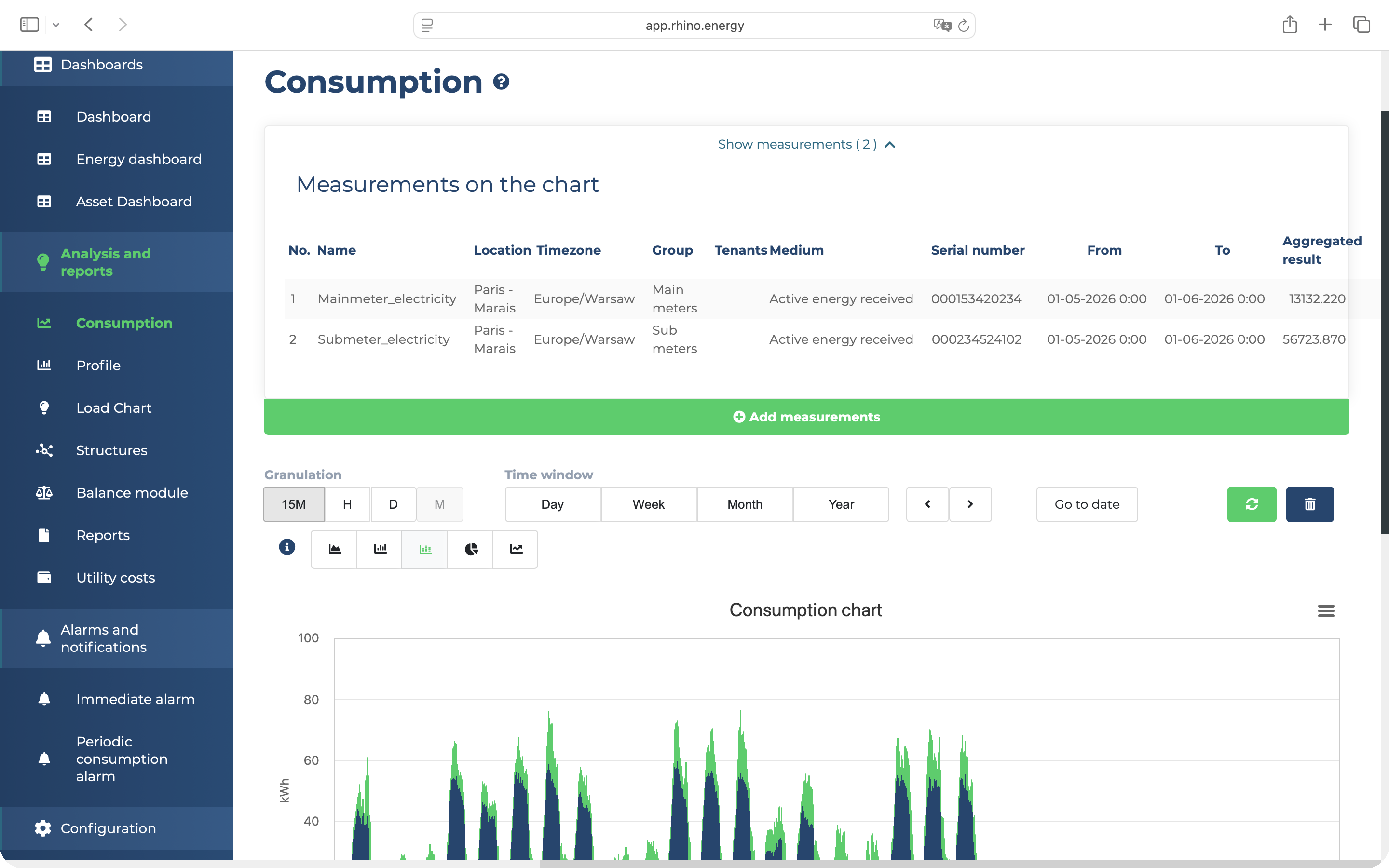
Once your utility providers are connected, all meter data flows automatically into the Rhino platform. The same interface, the same reporting, the same API, regardless of which connection method brought the data in.
Consumption monitoring across your full portfolio at building and submeter level
Threshold alerts when consumption deviates from expected patterns
ESG and billing reports generated automatically from live meter data
API access to push data into your own tools, BI platforms, or ESG software
Other connection paths
Not every building has a smart meter API.
Utility connectors work where smart meters are already in place. For everything else, Rhino has two more paths that cover the same utilities with the same data quality.
Path 1 of 3
Rhino Hardware
Where meters have no digital output or no remote connectivity, Rhino installs its own device on site. Works with any meter brand, any protocol. One device connects up to 32 meters. CE and FCC certified.
See Rhino HardwarePath 3 of 3
Third Party Infrastructure
Where a BMS, IoT gateway, or sub-metering system is already installed, Rhino connects through it. No new hardware, no changes to what is already in place. The existing infrastructure becomes a data source.
Third Party Infrastructure
Common questions
Utility connectors, answered.
A utility provider connector is a certified API connection between Rhino and your grid operator or utility provider's smart meter network. Where your provider has an approved data-sharing API, Rhino pulls your meter readings directly from that source. No hardware is installed on site. The connection is authorized once and then runs automatically, delivering data at regular intervals into the Rhino platform.
Rhino currently maintains connections to providers in the Netherlands, Belgium, Denmark, Spain, and several other European markets. Coverage is expanding as Rhino adds new provider connections. If your portfolio includes buildings in a market not yet listed, the Rhino team can advise on the best path for those sites. For markets without a utility connector, Rhino hardware covers the same utility data without any dependency on a provider API.
No. The authorization process uses the provider's official API access program. You grant Rhino access via the provider's own platform, where Rhino is listed as a registered data recipient. Your login credentials, passwords, and account details stay with you throughout. Rhino receives only the meter data the provider's API is designed to share.
This depends on what each provider's API supports. Electricity is available via all providers on the Rhino list. Gas, water, and heat coverage varies by market and provider. Where a provider only covers part of your utility data, Rhino uses its hardware or a third-party infrastructure connection to fill the gap. You end up with complete data across all utilities regardless of which combination of connection methods applies.
Rhino pulls data at 15-minute intervals from providers that support it. Some providers deliver data at hourly or daily resolution, depending on the API program. In all cases, Rhino displays data at the resolution the provider delivers. Where resolution differs between connection methods across your portfolio, the platform presents everything consistently so your reports stay comparable.
Rhino is continuously adding new provider connections. If your provider is not currently supported, the Rhino team will assess whether an API program exists and add it to the roadmap accordingly. In the meantime, Rhino hardware covers the same utility data without any dependency on a provider connection, and works with any meter brand in any market.
Further reading
From the Rhino blog.


Not sure whether the provider holding your data is connected? Name it and find out. New providers are added on request, so a provider that is not connected is one that is not connected yet.
See if your providers are connected.
Book a call and Rhino's team will map your portfolio's connection paths before you commit to anything.