
Water monitoring
Find the water you can't account for.
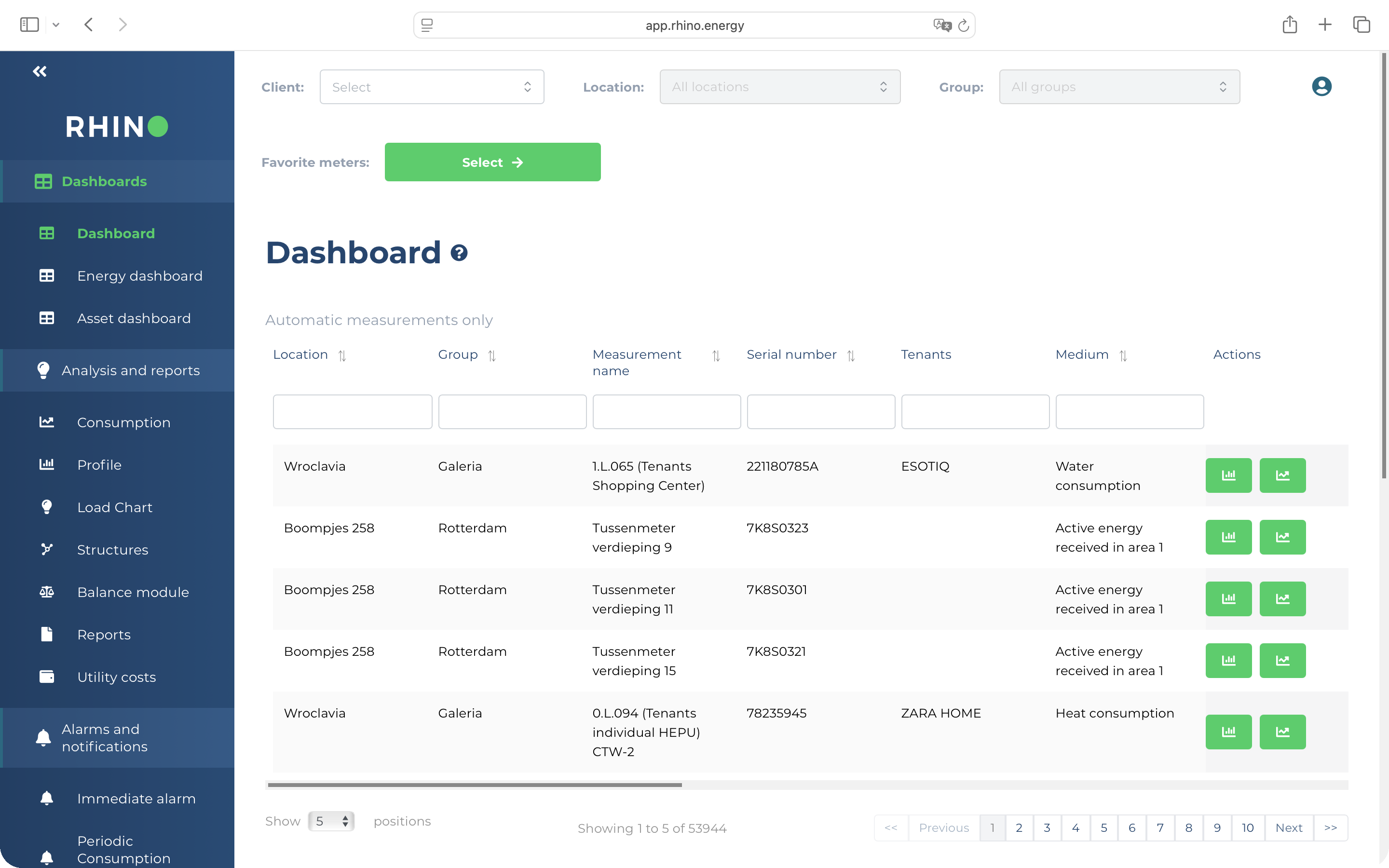
Rhino connects to every water meter and submeter in your buildings: main meter, tenant submeters, common-area risers, cooling towers. Consumption tracked continuously. Leaks detected before they show up on the invoice.
15 min
Real-time data granularity
Real-time
Leak detection alerts
−30%
Average cost savings
40+ countries
Active worldwide
What you see
Every meter. Every building. Any leak.
Not just cubic metres. Rhino captures flow rate, hourly intervals, and overnight baseline figures. The data your operations and ESG teams can actually work with.
Consumption
See what each meter used and when.
Every meter shows hourly and daily consumption against a rolling baseline. Compare building to building, week to week. Spot seasonal drift and the meters that don't follow the pattern.
Explore the dashboardLeak detection
Overnight flow that should be zero.
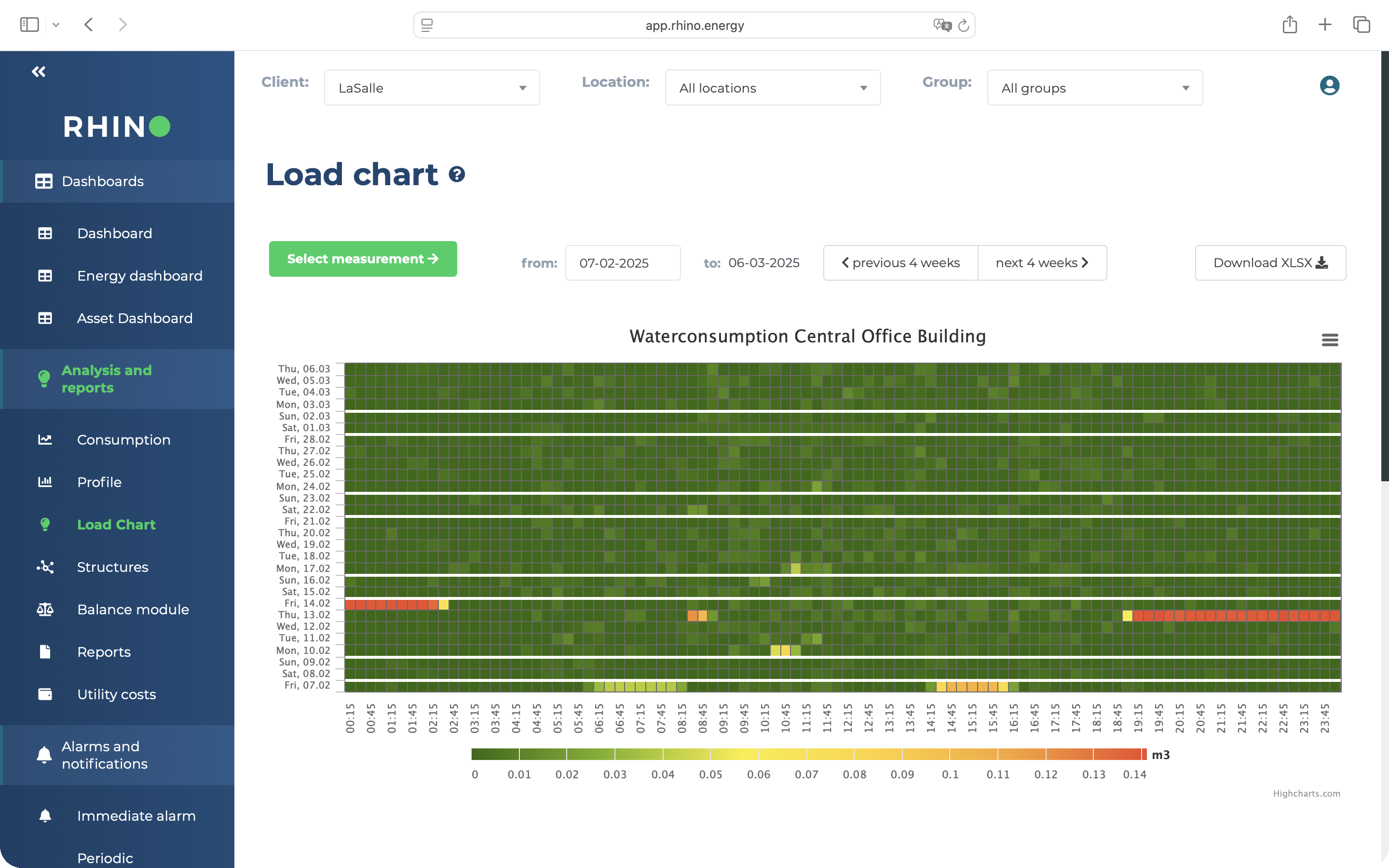
A meter that never reaches zero flow during closed hours is almost always a leak. Rhino tracks overnight minimum flow per meter and flags the ones that stay active. Most leaks surface inside the first week.
See how detection worksSubmeter breakdown
Where every cubic metre ends up.
Trace water from the main meter through tenant submeters, common areas, cooling towers, and irrigation. The flow map shows what's accounted for, and what isn't. The unaccounted share is often where the problem is.
See structure visualizationAlarms
An alert the moment flow goes wrong.
Set a flow threshold per meter. Rhino emails you the meter name, building, value, and timestamp the moment it's crossed. No more finding the problem in next month's reconciliation or the quarterly utility bill.
See how alarms workUtility Connectors
Cloud-to-cloud reads from smart meter networks and utility providers across Europe and North America. No hardware on site.
Rhino Hardware
Small, non-intrusive devices for meters that software can't reach. No rewiring, no downtime, low CAPEX. EU and US certified.
Third Party Infrastructure
Connect via an existing BMS, IoT gateway, or Modbus setup. Adds Rhino to what's already installed. No CAPEX, no replacement required.
What it gives you
Stop reconciling. Start acting.
Three things facility and energy managers do with Rhino water data from day one.
Leak response
Find it in days, not quarters.
Most leaks are invisible until the reconciliation. A running toilet, a valve left open, a pipe joint failing slowly, none of them show up in a walk-around. Rhino's overnight baseline flags them within hours. Most teams find their first issue inside the first week of going live.
Read a customer storyBREEAM water credits
Turn meter data into BREEAM points.
Rhino's automatic water metering with interval data and leak detection alarms maps directly to BREEAM Wat 01 and Wat 02 criteria. The consumption breakdown, alarm history, and submeter hierarchy your assessor needs: already in the platform, ready to export.
See the BREEAM credit guideESG reporting
The water data CSRD actually needs.
CSRD and the EU Taxonomy both require water consumption data per asset. Rhino gives you per-building intensity figures without manual collection runs, plus the audit trail to back them when your auditor asks.
See ESG reporting
Proof
Real water. Real portfolios.
Residential
449
apartments with automatic water monitoring across Amsterdam
Bouwinvest · Amsterdam · Electricity, water, and heat tracked per unit. Consumption data flows automatically into the portfolio dashboard, no manual reads required.
Read the case study
Office
Water. Visible.
across a mixed commercial portfolio. Every submeter, one dashboard.
Multiple asset types · Tenant submeters, common areas, and cooling towers all connected · Leak alerts active from day one
Talk to our team
Common questions
Water monitoring, answered.
Rhino connects to pulsed water meters, Modbus-based submeters, and wireless M-Bus devices. Most commercial buildings in Western Europe already have at least one compatible meter. For older sites without a pulse output, Rhino's hardware team can advise on low-cost retrofit options that keep CAPEX minimal.
Rhino monitors consumption continuously and triggers an alarm when flow is detected outside expected patterns, overnight usage when the building is empty, sudden spikes, or sustained low-level flow that indicates a dripping pipe or running toilet. Thresholds are configurable per meter and per time window.
Yes. Rhino's metering and data logging directly supports BREEAM Wat 01 (water consumption monitoring) and Wat 02 (leak detection and monitoring). The platform provides the granular, time-stamped consumption data assessors require, without needing to install a separate BMS or data logger. See the full BREEAM credit guide.
Yes. Rhino's meter hierarchy lets you group any meter, domestic, cooling, irrigation, fire suppression, into separate nodes in your building structure. Each node can have its own alarm thresholds and reporting logic, so cooling tower blowdown cycles don't trigger false leak alerts against domestic consumption.
Under CSRD, real estate companies must disclose water withdrawal and consumption per asset, with breakdowns by source where possible. Rhino captures this at meter level and aggregates it to portfolio level, making it ready for export into your ESRS E3 reporting workflow. The data is timestamped and audit-ready.
Further reading
From the Rhino blog.


Stop guessing what your water costs.
Connect your buildings to Rhino and see every water meter, with leak detection built in. Most teams find their first issue inside the first week.