



Third Party Infrastructure: Path 3 of 3
Your building
already talks.
Rhino listens.
Where a BMS, IoT gateway, or sub-metering system is already installed, Rhino connects directly to it. No new hardware. No changes to what's in place. Your existing infrastructure becomes a live data source.
Your portfolio
Infrastructure already installed.
BMS
IoT Gateway
Sub-metering
Path 3 of 3 · Active
Third Party Infrastructure
Direct integration with your existing BMS, IoT gateway, or sub-metering platform. Data flows through what's already installed into Rhino Cloud.




+ more
Rhino Cloud
Every meter. Every path.
Updated every 15 min
All utilities
No additional hardware required
Works with what's
already there.
Most commercial buildings already have a BMS, an IoT gateway, or a sub-metering system. Rhino connects directly to it. No new devices arrive on site. Nothing installed, nothing replaced.
Connects to existing infrastructure
Rhino integrates with BMS platforms, IoT gateways, LoRaWAN networks, and sub-metering systems already installed in your buildings. Your current setup stays completely intact. Rhino reads the data it already produces.
Direct integration partnerships
Each third-party connection is built and maintained as a direct API or protocol-level integration. Rhino is an authorized integration partner for every platform on the list. Connections are tested, validated, and supported end to end.
Live in days, not weeks
Once the integration is confirmed, data typically starts flowing within a few days. No installation appointments. No system integrator required. The Rhino team handles the technical setup from first confirmation to first data point.
Connected platforms
Direct integrations. Ready to go.
Rhino maintains direct integrations with BMS platforms, IoT networks, and sub-metering systems across European markets. New partners are added as the network grows.
Socomec DIRIS Digiware is one of the most widely installed electrical submetering systems in European commercial real estate. Rhino connects directly to Digiware gateways via Modbus TCP, pulling consumption data from your existing installation into a portfolio-wide view. No replacement, no manual exports, no CAPEX.
Connectivity
Modbus TCP
IEC 62053-22 Class 0.5
Zero CAPEX
Your system not listed? Let us know and we'll assess the integration.
The process
Three steps from existing system to data.
Getting a third-party integration live takes days, not weeks. Rhino handles the technical setup. Nothing changes in your existing infrastructure.
1
Identify
Rhino maps what BMS, IoT gateway, or sub-metering infrastructure is already in place across your buildings. This typically happens during the onboarding call. You describe what's installed, Rhino confirms whether an integration exists or can be built.
2
Connect
Rhino establishes the integration with your existing system via API or protocol. Nothing is modified, reconfigured, or replaced on site. Your BMS or IoT platform continues operating exactly as before. Rhino simply reads what it already produces.
3
Data in Rhino
Meter and sensor data flows directly into Rhino Cloud. Normalized, validated, and live. Available in your dashboard, in your ESG and billing reports, and via the Rhino API from day one. All utilities covered where your system supports it.
What you get
Infrastructure connected. Portfolio visible.
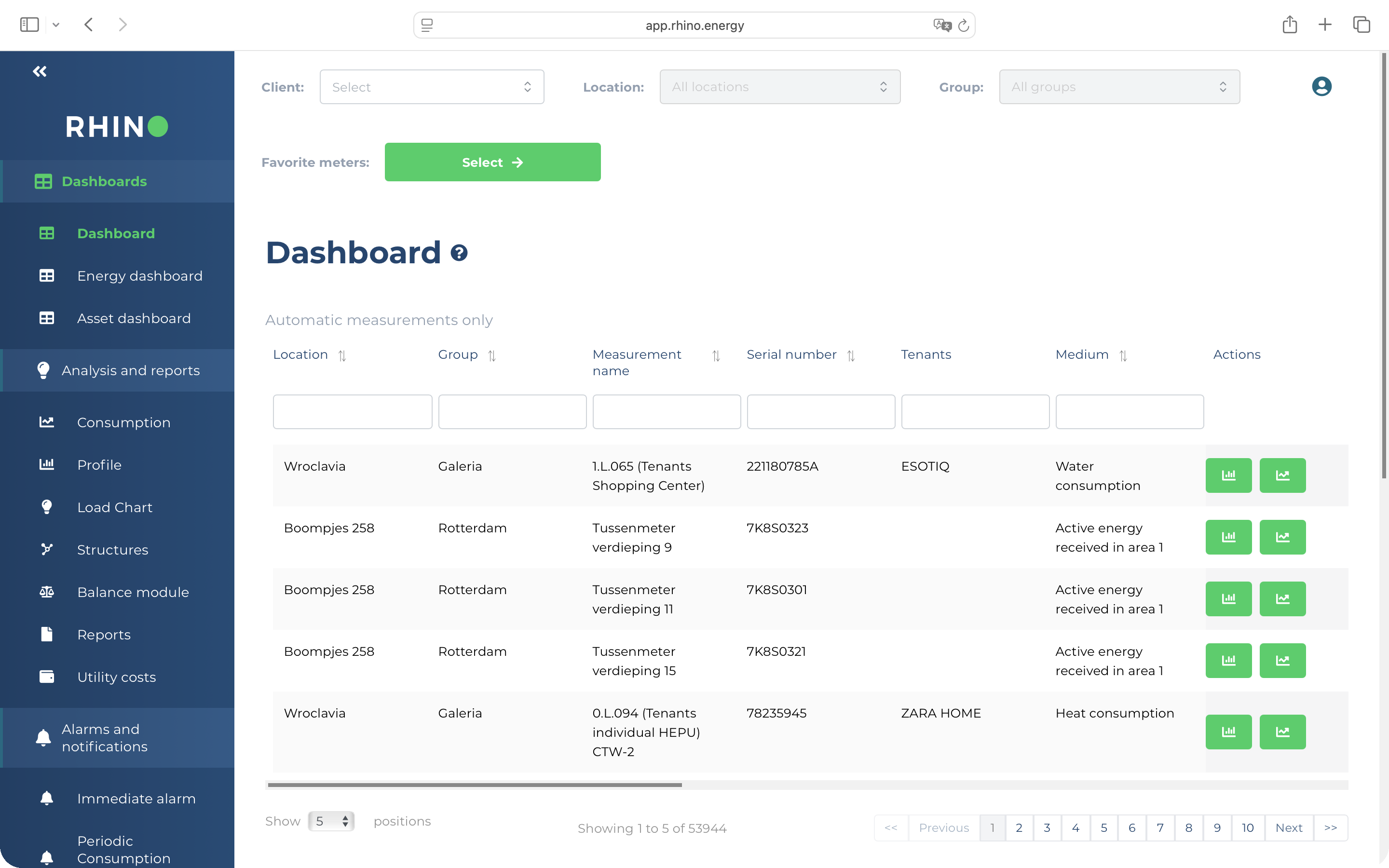
Once your existing systems are integrated, all meter data flows automatically into the Rhino platform. The same interface, the same reporting, the same API, regardless of which infrastructure brought the data in.
Consumption monitoring across your full portfolio at building and submeter level
Threshold alerts when consumption deviates from expected patterns
ESG and billing reports generated automatically from live meter data
API access to push data into your own tools, BI platforms, or ESG software
Other connection paths
No existing infrastructure? Covered.
Third party infrastructure works where a BMS, IoT gateway, or sub-metering system is already in place. For buildings without one, Rhino has two more paths that cover the same utilities with the same data quality.
Path 1 of 3
Rhino Hardware
Where meters have no digital output or no remote connectivity, Rhino installs its own device on site. Works with any meter brand, any protocol. One device connects up to 32 meters. CE and FCC certified.
See Rhino HardwarePath 2 of 3
Utility Provider Connectors
Where smart meters are already installed, Rhino connects directly to the grid operator or utility provider via a certified API. No hardware, no site visit. Data flowing within days of authorization.
See Utility Connectors
Common questions
Third party infrastructure, answered.
Rhino integrates with BMS platforms, IoT gateways, LoRaWAN networks, and sub-metering systems. Current integration partners include Shayp, The Things Industries, Waltero, Earn-e, Eniscope, and Smartvatten, among others. Coverage is expanding as new integrations are added. If your system is not on the current list, the Rhino team can assess compatibility and add it to the roadmap.
No. Rhino reads data from your existing system as a passive integration. Nothing is modified, reconfigured, or removed from your current setup. Your BMS, IoT gateway, or sub-metering system continues operating exactly as before. Rhino simply reads the data it already produces and normalizes it for the Rhino platform.
This depends on what your existing system is already collecting. Where a BMS or IoT gateway is pulling electricity, gas, water, or heat data from connected meters, Rhino can access all of it. Sub-metering systems that cover multiple utility types deliver all utilities into Rhino. For any gaps in coverage, Rhino hardware or utility provider connectors can fill in without disrupting the existing setup.
Most integrations are live within a few days of confirmation. The Rhino team handles the technical setup: API configuration, data normalization, and validation. You do not need to involve a system integrator or make any changes to your existing infrastructure. Once confirmed, the integration runs automatically and continuously.
Rhino is actively expanding its integration partner network. If your system is not currently listed, the Rhino team will assess whether an integration is possible and add it to the roadmap. In the meantime, Rhino hardware provides a direct path to meter data that works alongside or independently of any existing infrastructure, covering any meter brand in any market.
Further reading
From the Rhino blog.


Wondering whether Rhino reads the system you already have? Name it in the meter checker: it recognises platforms and gateways as well as meters.
Already have infrastructure in place?
Book a call and Rhino's team will assess your existing systems and confirm what's possible for your buildings before you commit to anything.