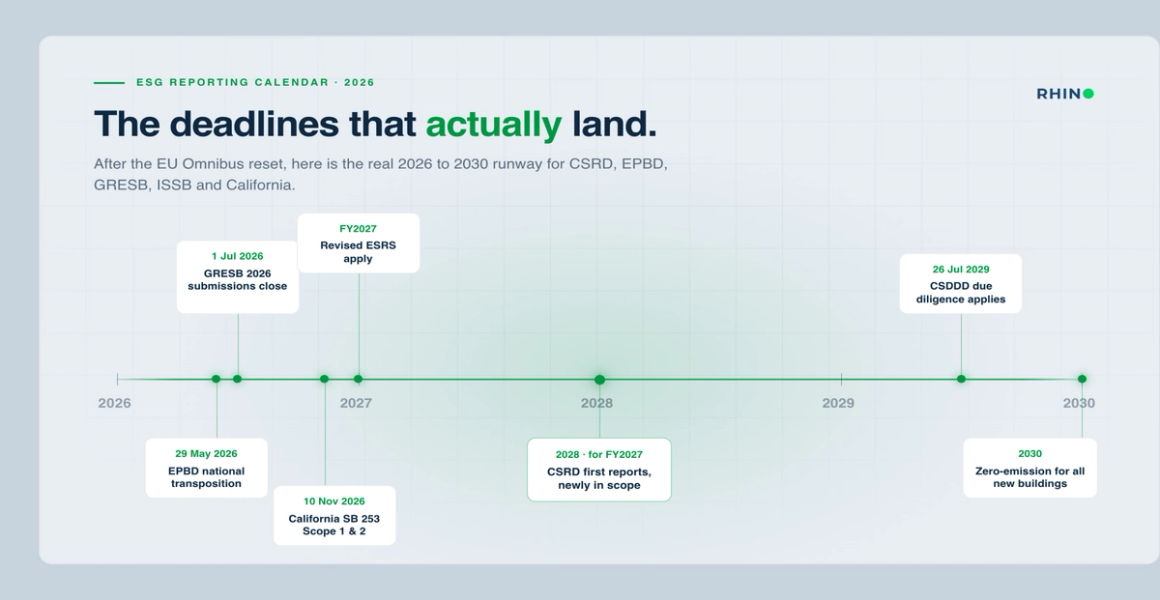
The ESG reporting calendar looks very different than it did a year ago. In 2025 the European Union hit pause on its own rules, then rewrote them. Deadlines moved, thresholds jumped, and a lot of companies that were bracing to report are now out of scope. If you are planning around dates you noted in 2024, most of them are wrong.
This guide sets out the current deadlines as of 2026, who they apply to, and what changed. It covers the EU rules, the building and energy directives that hit real estate directly, the global ISSB baseline, the US picture, and GRESB. One thing runs through all of it: every framework is built on data you have to be able to prove. That is the part most portfolios are not ready for.
What changed: the EU Omnibus reset
Two moves reshaped the European timeline.
First, in April 2025 the EU adopted the "stop the clock" directive. It pushed the next waves of CSRD reporting back by two years and delayed the due diligence rules, buying time while the bigger rewrite went through.
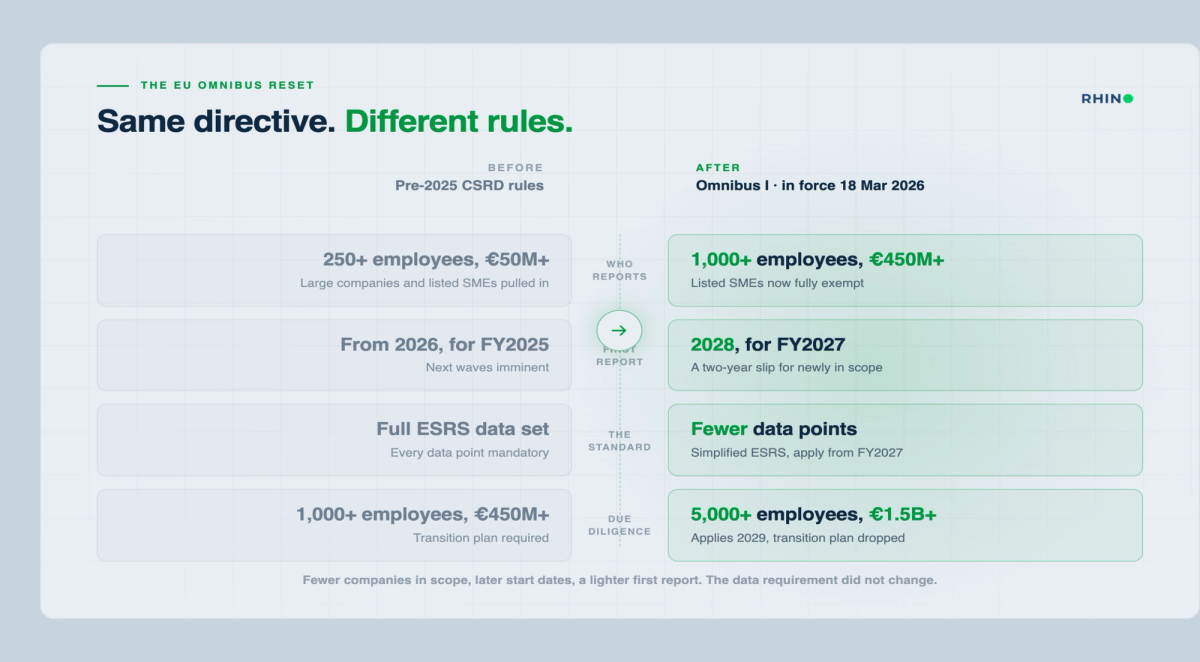
Second, that rewrite, the Omnibus I package, became law. It was published in the Official Journal in February 2026 as Directive (EU) 2026/470 and entered into force on 18 March 2026. It did not just delay the rules. It narrowed who they apply to, cut the number of data points, and simplified the reporting standards.
The result: fewer companies in scope, later start dates, and a lighter first report. The obligation to have accurate energy and utility data did not go away. If anything, the companies still in scope are the large portfolios where getting the data right is hardest.
EU deadlines
CSRD: who reports, and when
The Corporate Sustainability Reporting Directive is the EU's main sustainability reporting rule. After the Omnibus rewrite, it applies to far fewer companies.
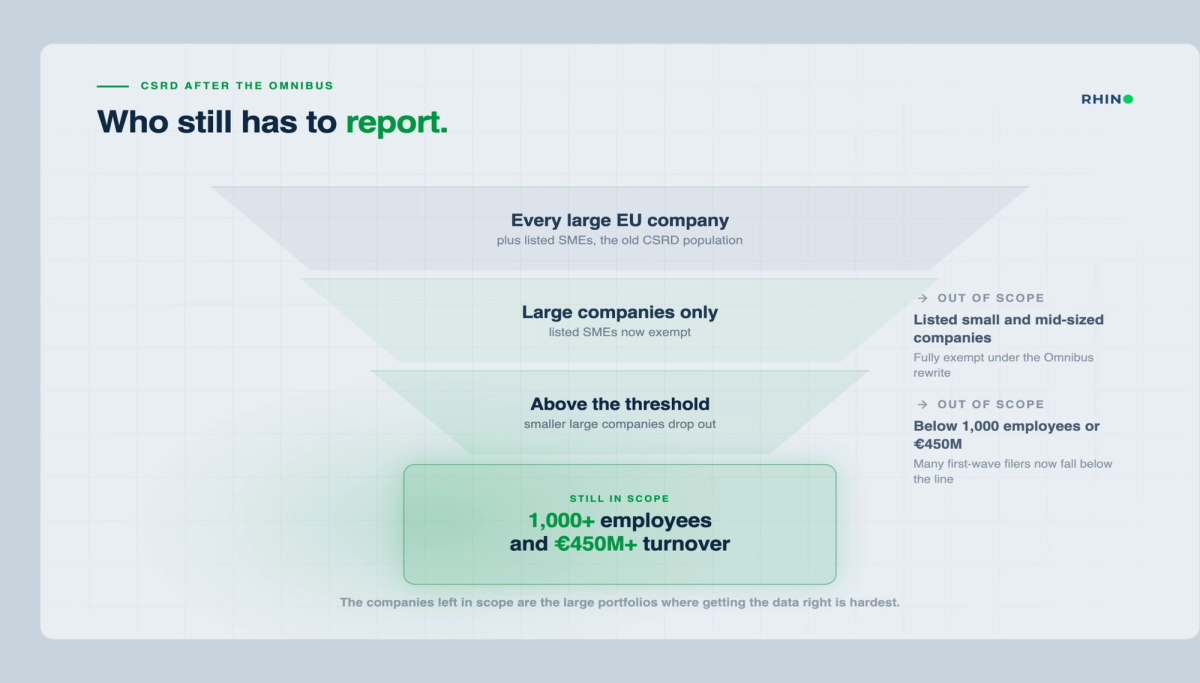
Only large companies with more than 1,000 employees and over €450 million in net turnover now have to report. Listed small and medium-sized companies, which the old rules would have pulled in, are fully exempt. The largest first-wave companies that already filed for financial year 2024 continue, as long as they stay above the new threshold. Many that fell below it drop out.
For companies still in scope, the current timeline is:
| Company group | First report | Financial year covered |
|---|---|---|
| Large companies already reporting | Continue (first filed in 2025) | 2024 onward |
| Companies newly in scope | 2028 | 2027 |
| Non-EU parent companies with major EU turnover | 2029 | 2028 |
Limited assurance of the report stays mandatory, with a dedicated assurance standard due by 1 July 2027.
ESRS: the standards you report against
The European Sustainability Reporting Standards are the detailed rules for what a CSRD report must contain. The Omnibus process cut the number of mandatory data points and simplified the set. The revised standards are expected to apply from financial year 2027, with voluntary early use possible for financial year 2026. Digital tagging of the report is postponed until the detailed rules are set.
EU Taxonomy: simpler, and tied to CSRD scope
The EU Taxonomy defines which economic activities count as environmentally sustainable, and in-scope companies report how much of their turnover, capex and opex aligns. Because Taxonomy reporting is tied to CSRD scope, the same threshold change means fewer companies report.
A simplification act took effect on 8 January 2026 and applies from 1 January 2026. It adds a materiality threshold, so activities below 10% of turnover can be left out, and eases the "do no significant harm" checks. Further changes are consulted on for application from 1 January 2027.
CSDDD: due diligence, pushed out
The Corporate Sustainability Due Diligence Directive covers human rights and environmental due diligence across the value chain. The Omnibus package raised its thresholds and pushed its timeline out.
Member states must transpose it by 26 July 2028, and the rules apply from 26 July 2029. It now applies to companies with more than 5,000 employees and over €1.5 billion in turnover. The requirement to adopt a climate transition plan was dropped.
SFDR: under review
The Sustainable Finance Disclosure Regulation, which governs how funds and financial products disclose sustainability, is being rewritten in parallel. A revised version is working through the EU institutions during 2026 and will bring new product categories and labels. If you manage or market financial products, treat the current rules as a moving target this year.
Building and energy deadlines that hit real estate directly
Two directives apply to buildings whether or not you report under CSRD. For real estate, these are the ones that turn into hard obligations on the ground.
EPBD: the recast Energy Performance of Buildings Directive
The recast EPBD entered into force in May 2024, and member states must write it into national law by 29 May 2026. From there the dates that matter for owners:
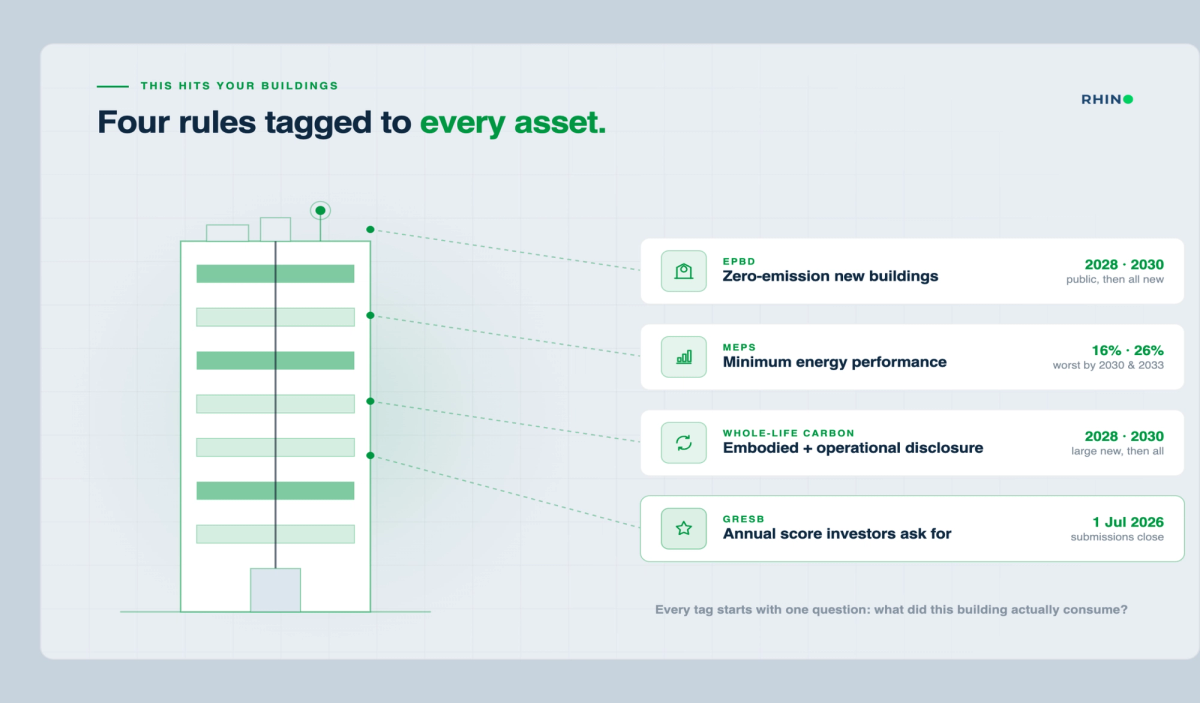
- All new public buildings must be zero-emission from 2028, and all other new buildings from 2030.
- Minimum energy performance standards target the worst-performing non-residential buildings: renovate the worst 16% by 2030 and the worst 26% by 2033.
- Whole-life carbon disclosure phases in for large new buildings from 2028 and all new buildings from 2030.
Meeting these standards, and proving you have, starts with knowing what each building actually consumes.
EED: the Energy Efficiency Directive
The recast Energy Efficiency Directive had a transposition deadline of 11 October 2025, so it is now landing in national law. It pushes large energy users toward energy management systems and raises the bloc's annual savings targets. In practice it means more buildings need measured, auditable consumption data rather than estimates.
The global baseline: ISSB (IFRS S1 and S2)
Outside the EU, the reporting standard converging fastest is the ISSB's, published by the IFRS Foundation. IFRS S1 covers general sustainability disclosure and IFRS S2 covers climate. More than 20 jurisdictions have adopted or proposed them, and they are becoming the baseline investors expect worldwide.
Where they already bite:
- Mandatory from the start of 2026 in several markets, including Chile, Qatar and Mexico.
- Australia is phased: large companies from 1 January 2025, medium from 1 July 2026, smaller from 1 July 2027.
- Brazil, Malaysia, New Zealand, South Korea and others are adopting on their own timelines.
Targeted amendments to IFRS S2 apply for reporting periods beginning on or after 1 January 2027.
UK: UK SRS
The UK published its own standards, UK SRS S1 and S2, in February 2026, closely aligned to the ISSB set. They are voluntary for now, but the financial regulator is consulting on making them mandatory for listed companies from 1 January 2027.
United States
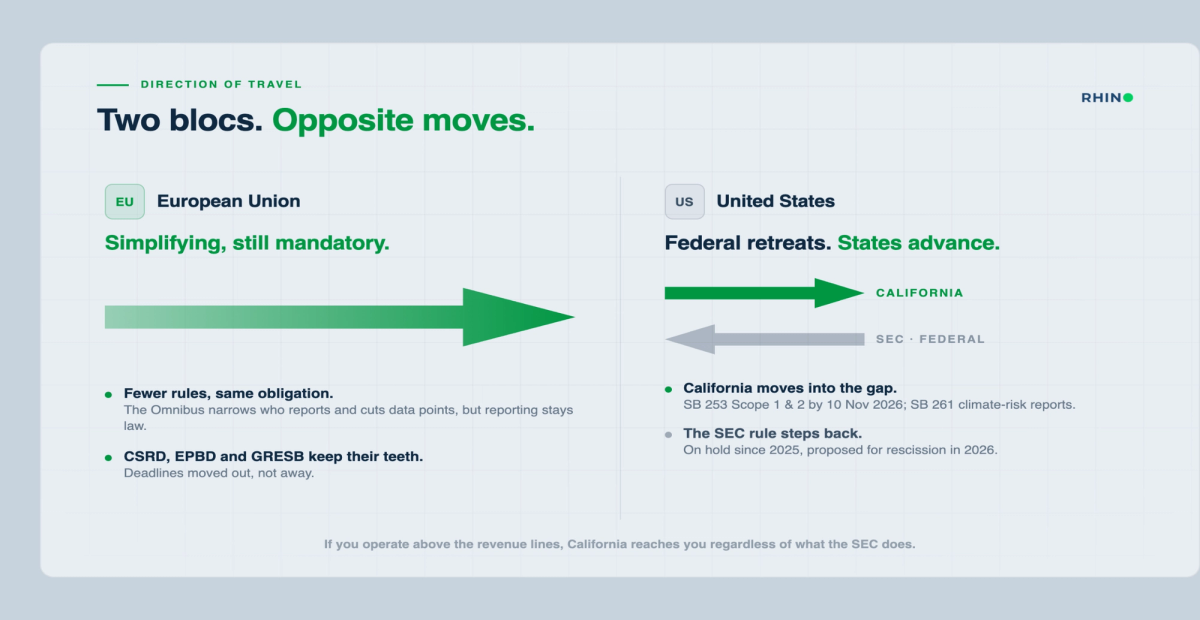
The US picture is the opposite of the EU one: the federal rule is retreating while state rules advance.
SEC climate rule: effectively on hold
The SEC voted to stop defending its climate disclosure rule in March 2025, and in May 2026 proposed to rescind it entirely. For now, treat the federal rule as not in force. It does not remove climate reporting obligations that come from state law or from doing business abroad.
California: SB 253 and SB 261
California moved into the gap left by the SEC.
- SB 253 requires companies with over $1 billion in revenue doing business in California to report Scope 1 and 2 emissions, with the first deadline deferred to 10 November 2026, and Scope 3 from 2027. The regulator is applying good-faith enforcement in the first year.
- SB 261 requires companies with over $500 million in revenue to publish a biennial climate risk report. Its statutory start date was 1 January 2026, but enforcement is paused while a court challenge plays out, with a new date to follow.
If you have US operations above these revenue lines, California reaches you regardless of what the SEC does.
The one that scores you every year: GRESB
GRESB is not law, but for real estate it is often the most immediate deadline, because investors ask for the score. It runs on an annual cycle. The 2026 real estate assessment opens in April, submissions close on 1 July 2026, and the assessment covers 2025 performance data. Preliminary results land in September, final results in October. Submeter-level consumption data is a scored input, not a nice-to-have.
Key ESG dates at a glance
| Framework | Applies to | Key date |
|---|---|---|
| CSRD, newly in scope | Large EU companies, 1,000+ employees and €450M+ turnover | First report 2028, for FY2027 |
| CSRD, non-EU parents | Non-EU groups with major EU turnover | First report 2029, for FY2028 |
| CSRD assurance standard | CSRD reporters | Due by 1 July 2027 |
| Revised ESRS | CSRD reporters | Apply from FY2027, voluntary for 2026 |
| EU Taxonomy simplification | CSRD reporters | In effect 1 January 2026, more from 2027 |
| CSDDD | 5,000+ employees and €1.5B+ turnover | Applies from 26 July 2029 |
| EPBD | New and worst-performing buildings | Transposition 29 May 2026; zero-emission new buildings 2028 and 2030 |
| EED | Large energy users | Transposition 11 October 2025 |
| ISSB (IFRS S1 and S2) | Varies by market | Mandatory from 2026 in several; S2 amendments from 2027 |
| UK SRS | UK listed companies | Voluntary now, proposed mandatory from 2027 |
| US SEC climate rule | US filers | Proposed for rescission, on hold |
| California SB 253 | Over $1B revenue in California | Scope 1 and 2 by 10 November 2026, Scope 3 from 2027 |
| California SB 261 | Over $500M revenue in California | Climate risk report, date pending |
| GRESB 2026 | Real estate portfolios | Submissions close 1 July 2026, covering 2025 data |
Every deadline on this list runs on measured energy data from your buildings. Rhino collects it automatically from every meter, so the data is ready before the deadline is. Book a demo to see it on your portfolio.
What this means if you own or manage real estate
Strip away the acronyms and every one of these frameworks asks the same first question: what did each building actually consume, and can you prove it. CSRD and the ISSB standards want measured emissions. The EPBD wants performance you can evidence. GRESB scores you on submeter data. California wants Scope 1 and 2 you can stand behind.
The deadlines moved. The data requirement did not. And the companies still in scope after the Omnibus cut are the large portfolios where consumption data is spread across many buildings, meter types and country systems. That is exactly where manual reads and spreadsheets break down, and where a wrong number in a report is hardest to catch.
The buildings you manage produce this data already. The gap is collecting it completely, keeping it accurate, and having it ready when the report is due rather than scrambling for it the week before.
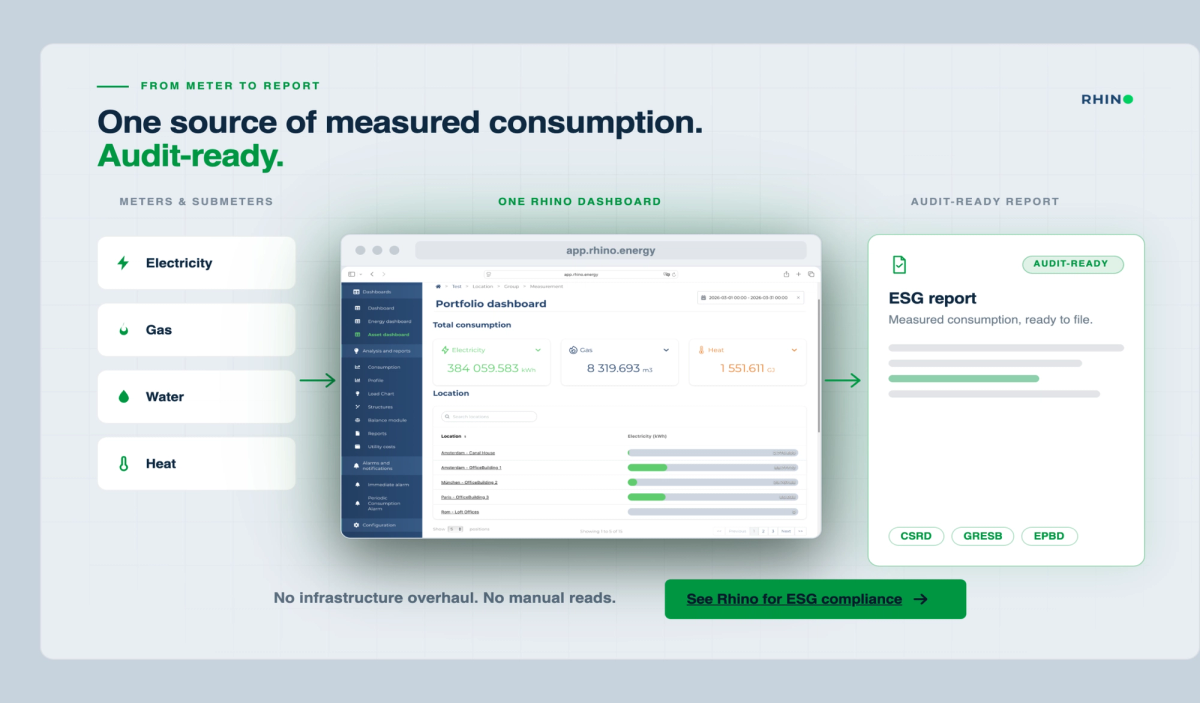
Rhino collects and automates utility data across commercial real estate portfolios: electricity, gas, water and heat, including submeters, through smart-meter connections or its own hardware, without an infrastructure overhaul. That gives your ESG report one source of measured consumption instead of a chase across building managers.
See how Rhino turns utility data into audit-ready ESG reporting
Frequently asked questions
Did the EU delay ESG reporting deadlines?
Yes. The 2025 "stop the clock" directive pushed the next CSRD waves back two years, and the 2026 Omnibus I rewrite narrowed who has to report and simplified the standards. Companies newly in scope now file their first CSRD report in 2028, covering financial year 2027.
Who still has to report under CSRD?
Large companies with more than 1,000 employees and over €450 million in net turnover. Listed small and medium-sized companies are now exempt.
What are the ESG deadlines for real estate specifically?
Beyond CSRD, the EPBD sets zero-emission targets for new buildings from 2028 and 2030 and minimum standards for the worst performers by 2030 and 2033, and GRESB runs an annual cycle with 2026 submissions closing on 1 July 2026.
Is the US SEC climate rule still in force?
No. The SEC stopped defending it in 2025 and proposed to rescind it in 2026. State rules such as California's SB 253 and SB 261 still apply.