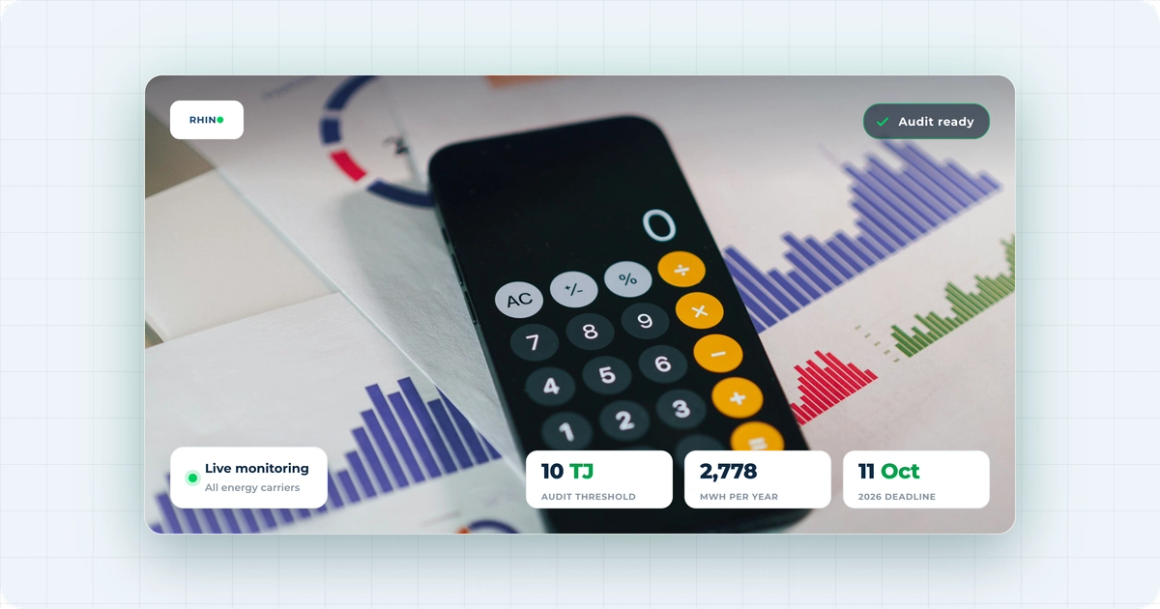
If your company used more than 10 terajoules of energy a year on average over the last three years, you owe a completed energy audit by 11 October 2026. That is roughly 2,778 megawatt hours, and a portfolio of three or four mid-size office buildings clears it without trying.
Most real estate companies have not checked. The obligation moved in the 2023 recast of the Energy Efficiency Directive, and it stopped being a question about how many people you employ. This post covers who is now in scope, how to work out whether you cross the threshold, what the audit asks for, and the data problem that turns a straightforward audit into a six-week scramble.
What is the EED energy audit obligation?
The energy audit obligation sits in Article 11 of the Energy Efficiency Directive (EU) 2023/1791. It requires any enterprise whose average annual final energy consumption exceeded 10 terajoules (TJ) over the previous three years to complete an energy audit, and to repeat it at least every four years. The first audit under the recast rules is due by 11 October 2026. Enterprises above 85 TJ face a heavier obligation and must run a certified energy management system instead.
Why companies that were exempt before are now in scope
The trigger changed from company size to energy consumption. Under the previous directive, the audit obligation caught "large enterprises", defined by headcount and turnover: 250 or more employees, or turnover above 50 million euros with a balance sheet total above 43 million euros. Small and medium-sized enterprises were exempt regardless of how much energy they burned.
The 2023 recast dropped that test. It now measures energy, not people. A property company with 30 staff and 40 buildings was comfortably exempt under the old rules and is comfortably in scope under the new ones. Real estate is unusually exposed to this change, because the sector runs high energy consumption on small headcounts.
How much energy is 10 TJ in building terms?
Terajoules are not a unit anyone in real estate works in, so convert before you assess. One terajoule equals 277.8 megawatt hours (MWh). The thresholds translate like this:
| What the threshold is | What it equals in megawatt hours | Roughly how much floor area that is |
|---|---|---|
| The audit threshold is 10 TJ of average annual final energy consumption over the previous three years. | The figure comes to 2,778 MWh per year. | At 150 kWh per square meter per year, this is about 18,500 m2 of office space, or three to four mid-size buildings. |
| The energy management system threshold is 85 TJ over the same period. | The figure comes to 23,611 MWh per year. | At the same intensity, this is about 157,000 m2, or a portfolio of roughly 25 to 30 mid-size offices. |
The floor area column is an illustration, not a legal test. 150 kWh per square meter per year is a common European office benchmark, and your actual intensity decides where you land. Logistics and retail sit lower per square meter, data-heavy and hospitality assets sit much higher.
Two details catch people out. The threshold counts all energy carriers together, so electricity, gas, district heat and fuel add up rather than being assessed separately. And it applies at enterprise level, aggregated across every site you operate, not building by building. A portfolio where no single asset looks significant can still cross the line comfortably in aggregate.
What counts toward your threshold if you are a landlord
Energy you supply to the shared parts of a tenanted building counts as yours. That much is uncontroversial: heating a lobby is your activity, not your tenant's.
The part that surprises people is the treatment of tenant energy. Where a landlord supplies energy to a tenant and the amount is not separately measured and known to that tenant, national implementations generally require the landlord to count it as their own. The UK's Energy Savings Opportunity Scheme states this explicitly, and the same logic runs through most member state guidance.
Read that the other way around and it becomes a practical lever. Every tenant supply you cannot measure inflates your own assessed consumption and can push you over a threshold you would otherwise sit under. Submetering does not just settle arguments with tenants, it narrows your own regulatory scope. We covered the dispute side of that in why tenants dispute their utility recharge.
What the audit actually asks for
An Article 11 audit is not a walk round with a clipboard. It has to be proportionate, representative, and built on real operating data. Three requirements do most of the damage to unprepared portfolios.
Coverage. The audit must cover a substantial majority of your total final energy consumption, commonly set at 80% in national implementations. You cannot audit your three best buildings and call it done.
Measured data over estimates. Auditors work from actual consumption profiles. Annual invoice totals will technically satisfy some national schemes, but they cannot support the load profile analysis that produces credible savings recommendations, and an audit that recommends nothing useful is an audit you will pay for twice.
An action plan you publish. The recast added teeth. After the audit you must produce a concrete action plan setting out how you will implement the recommendations, and publish information on that implementation. The audit is no longer a document that goes in a drawer.
The 85 TJ tier and the October 2027 deadline
Above 85 TJ of average annual consumption, the audit is not enough. Those enterprises must implement a certified energy management system, with a deadline of 11 October 2027. In practice this means ISO 50001 certification covering the operation.
The trade runs both ways. An enterprise that already holds ISO 50001 certification is generally exempt from the separate audit obligation, provided the certified system covers enough of its consumption. If you sit above 85 TJ, going straight to a management system rather than commissioning an audit first is usually the cheaper path.
The difference between the two obligations is continuity. An audit is a snapshot every four years. A management system requires you to monitor consumption continuously, act on what you find, and measure whether the action worked. You cannot run one on annual meter reads.
Where portfolios get caught out
The honest version: if you have a small portfolio, a competent facilities team and clean annual invoices, you can get through a first audit without changing anything. Plenty of companies will. The auditor will work with what you have and produce something defensible.
What that approach does not survive is the second cycle. The action plan you publish in 2026 becomes the thing you are measured against in 2030, and you cannot demonstrate that a measure delivered savings without consumption data from before and after it. Portfolios that treat the 2026 audit as a document exercise tend to discover in 2027 that they have committed in public to savings they have no way to evidence.
The other common failure is timing. Data collection is the long pole. Getting meter access agreed, submeters mapped to the right tenants and a clean 12 months of history assembled across a portfolio takes months, not weeks. Eight weeks before a deadline is late to start, which is the main reason this post exists now rather than in October. The audit also lands in a year already carrying CSRD and GRESB workload, so check it against the full list of upcoming ESG reporting deadlines before you plan resourcing.
Where Rhino fits
Rhino is the data layer between your meters and whoever needs the numbers. It collects electricity, gas, water and heat data automatically across a portfolio, including submeters, at 15-minute granularity, through smart meter connections, utility APIs, or Rhino hardware where a building needs it.
For an Article 11 audit that matters in three specific ways. You can calculate your actual position against the 10 TJ threshold across all energy carriers instead of estimating it. Your auditor gets load profiles rather than invoice totals, which is what turns a compliance exercise into recommendations worth implementing. And when the action plan comes due, you have the before-and-after consumption record that proves a measure worked.
Rhino does not run the audit and does not certify anything. It feeds the people who do.
Frequently asked questions
Who has to complete an energy audit by 11 October 2026?
Any enterprise whose average annual final energy consumption exceeded 10 terajoules over the previous three years, counting all energy carriers together across all sites. Company size no longer matters. Small and medium-sized enterprises that were exempt under the previous directive are in scope if they cross the energy threshold.
How much is 10 terajoules in megawatt hours?
10 terajoules equals 2,778 megawatt hours per year, since one terajoule is 277.8 MWh. For a commercial property portfolio at a typical office energy intensity of 150 kWh per square meter per year, that is roughly 18,500 square meters of floor area, or three to four mid-size office buildings.
Does tenant energy count toward my threshold as a landlord?
Energy you supply to shared parts counts as yours. Energy you supply to a tenant generally counts as yours too, where the amount is not separately measured and known to that tenant. Submetering tenant supplies moves that consumption off your assessment, which can keep a portfolio below a threshold.
Can I use ISO 50001 instead of an energy audit?
Yes. An enterprise with a certified ISO 50001 energy management system covering a sufficient share of its consumption is generally exempt from the separate audit obligation. Above 85 terajoules of average annual consumption a certified management system is mandatory rather than optional, with a deadline of 11 October 2027.
What happens after the audit?
You must produce a concrete action plan setting out how you will implement the audit recommendations, and publish information on that implementation. Audits repeat at least every four years, so the savings you commit to in 2026 become the baseline you are assessed against in the following cycle.
Working out where your portfolio sits against the 10 TJ threshold takes a complete picture of consumption across every building and every energy carrier. If that picture is currently spread across invoices and spreadsheets, see how Rhino automates utility data for ESG compliance.