BERDO compliance comes down to one number per building: emissions per square foot for the calendar year, built from every fuel the building uses and every tenant space in it. When part of that data is missing in May, Boston's rules fill the gap for you, and they fill it high.
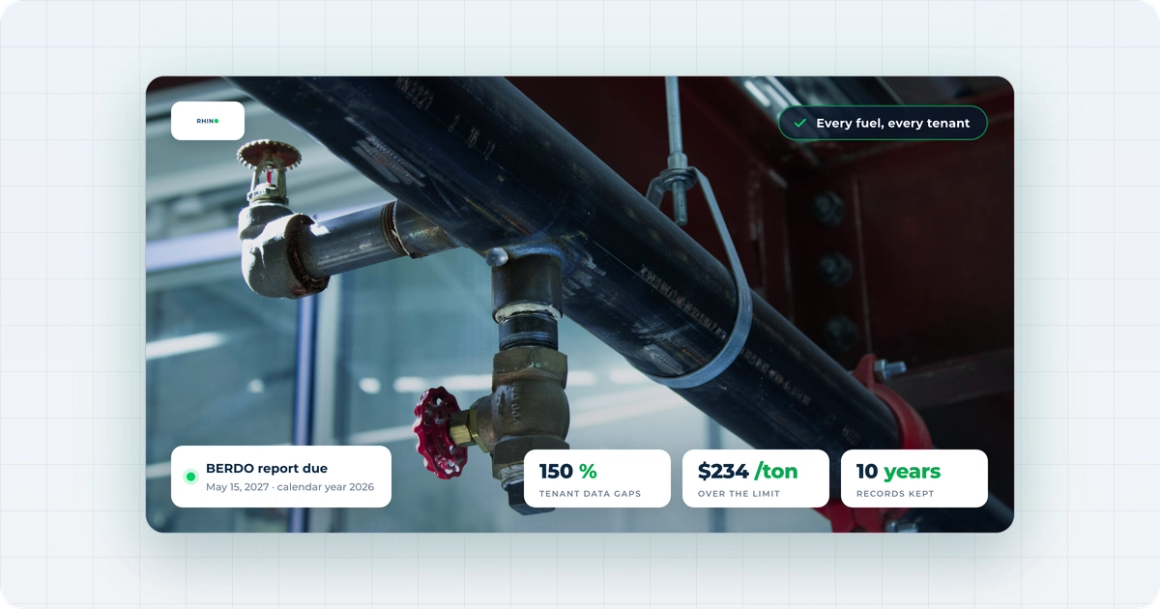
This checklist is for the report due May 15, 2027, which covers calendar year 2026. It sets out what to collect, who holds it, when each piece is due, and the three places buildings most often lose data: gas and steam, district energy, and tenant spaces. For the rules themselves, with limits by building type and fines, see our guide to Boston BERDO 2.0.
What is BERDO compliance?
BERDO compliance means meeting the reporting and emissions rules of Boston's Building Emissions Reduction and Disclosure Ordinance, known as BERDO 2.0. Owners of non-residential buildings of 20,000 sq ft or more and residential buildings with 15 or more units report a year of energy and water use by May 15. Buildings of 35,000 sq ft or 35 units and up must also stay under an emissions limit per square foot that falls every five years, to zero in 2050.
How does Boston turn your meter data into a BERDO number?
The City converts each energy type into emissions, adds them up and divides by floor area. Your data supplies the consumption. The City supplies the emissions factors, published by April 15 each year: ISO New England data for electricity, Portfolio Manager factors for fuels, and verified factors from each district energy operator.
The result is compared with the limit for your building use, in kilograms of CO2e per square foot per year. An office is held to 5.3 for 2025 to 2029, then 3.2 from 2030. For a 100,000 sq ft office, that is a budget of 530 metric tons of CO2e a year. Each ton over the limit costs $234 as an alternative compliance payment, so 50 tons over is $11,700.
That makes every overstated reading a cost. A gas bill estimated high, or a tenant space booked at a penalty rate, moves the building toward its limit as surely as energy that was really used.
What data does a BERDO report need?
A BERDO report needs whole-building data: energy use for every energy type and water use for the entire building, tenant spaces included, reported without cost through ENERGY STAR Portfolio Manager. On top of that come the building's uses, its floor area and proof for any renewable energy certificates (RECs) or power purchase agreements, which can only offset the electricity share.
| What do you need to collect? | Where does it usually come from? | Where does it usually go missing? |
|---|---|---|
| You need electricity for the whole building, common areas and tenant spaces included. | It comes from the owner's utility accounts, plus each tenant's own account where tenants are separately metered. | Tenant-paid accounts often never reach the owner, so the building total stays short until someone asks. |
| You need natural gas for heating, hot water and kitchens. | It comes from the building's gas account, plus tenant accounts for restaurants or other tenants on their own meter. | Gas meters are read less often than electricity meters, so bills can carry estimates that are corrected months later. |
| You need steam, hot water and chilled water from a district energy system. | Consumption comes from the provider's invoices, and the emissions factor comes from the operator through the City. | The unit on the invoice does not always match what Portfolio Manager expects, and a conversion error goes straight into the emissions figure. |
| You need fuel oil, propane and backup generator fuel. | It comes from delivery tickets and generator logs kept on site. | Deliveries are not consumption, and generator or EV charging energy can only be deducted with records that back it up. |
| You need water use for the whole building. | It comes from the water account and any tenant water accounts. | Water does not count toward emissions, so it gets forgotten, but a report without it is incomplete. |
| You need the building's uses and gross floor area. | They come from Boston Assessing Department records, or your own measurement with supporting documents. | A use that takes at least 10% of floor area or energy can qualify the building for a blended limit, and owners often leave it out. |
When is each piece of BERDO data due?
Each piece has its own date, and the tenant window opens and closes before most teams start on the report. For the report due in 2027:
| When does it happen? | What has to happen by then? |
|---|---|
| January 1 to 31, 2027 | Owners send written requests to tenants for their 2026 energy and water data. The ordinance only allows requests in this window. |
| February 28, 2027 | Non-residential tenants must report their separately metered use for 2026. |
| April 1, 2027 | District energy operators submit verified emissions factors for their systems. |
| April 15, 2027 | The City adopts the emissions factors used to calculate compliance. |
| May 15, 2027 | The BERDO report for 2026 is due through Portfolio Manager and the BERDO Reporting Form. |
| Within 30 days of new information | If new information changes the building's emissions, energy or water use by 2% or more, the owner must send corrected data. |
In 2026 the City moved the deadline to August 15 for all owners. That was a decision for 2026. Plan for May 15, and request an alternative date before the deadline if you need one.
Where do buildings usually miss BERDO data?
Three gaps cause most of the trouble, and none of them shows up until the report is being put together.
Gas and steam: the most weight, the fewest reads
Gas and district steam are the fuels whose emissions no REC can offset, and they are the meters read least often. A gas bill can carry an estimated read that the utility trues up months later. If that correction changes the building's emissions by 2% or more after you have reported, you have 30 days to resubmit. Monthly measured gas and steam data closes the gap before it opens.
District energy: their factor, your consumption
For steam, hot water and chilled water from a district system, the emissions factor comes from the operator, verified by a third party and submitted to the City by April 1. Your part is the consumption, in the right unit, for every month. Check the invoice unit against Portfolio Manager before the numbers go in.
Tenant spaces: the 150% rule
Tenant data is the gap with a penalty built in. If tenants do not report, the owner must still report the whole building, and the BERDO regulations set how to fill the hole. With actual data for at least 50% of a building use, the missing space is extrapolated at the average energy use intensity of the known space, multiplied by 150%. Below 50%, the City's default values apply instead.
A worked example: the tenants who reported average 60 kBtu per sq ft. A 20,000 sq ft space that never answered is booked at 90 kBtu per sq ft, 1.8 million kBtu instead of 1.2 million. The building carries the emissions of 600,000 kBtu nobody used.
Owners must also document that they asked: a written request to the tenant's latest contact details at least twice, and a written report to the City on any non-residential tenant that did not respond. Residential tenants have no obligation to report. The City provides authorization forms that let owners pull a tenant's data from Eversource and National Grid with the tenant's consent.
What will the third-party verifier check in 2031?
The verifier will check every year from 2026 to 2030, so the data you collect now is part of that review. Buildings held to limits from 2025 verified their 2025 data in 2026. The next Verification Year is 2031, and it covers the five calendar years before it. The verifier must be a qualified energy professional who is not on the staff of the owner or the management company.
Owners must keep the records behind each report for ten years: everything submitted, the backup that substantiates energy and water data, tenant requests, verifications and extension requests. If verification finds a discrepancy with what the owner self-certified, and it is not reconciled, the fine is $1,000 to $5,000. The easiest data to verify traces back to the meter: monthly totals per meter, with the timestamped readings behind them.
Where does Rhino fit into BERDO compliance?
Rhino is the data layer under the report, not the report itself. It reads all utilities, including heat meters on steam and hot water, through existing smart meters or Rhino hardware, which is FCC certified for the US. Data arrives every 15 minutes and is stored from day one.
That changes three things for a Boston owner. Gas and steam stop being meters you see once a month on a bill that may be estimated. Where tenant spaces are submetered, their consumption is already in the platform, assigned to the right tenant, before the January request window opens. And when the verifier arrives in 2031, every monthly total in Portfolio Manager traces back to meter readings.
Rhino does not file the report, set emissions factors or verify data. For a single-tenant building where the owner holds every utility account and the bills are based on actual reads, monthly bills may be nearly enough. The case for metered data grows with every tenant, every gas account and every district energy invoice.
For the same problem in New York, see how Local Law 97 works and why continuous meter data helps. To see how Rhino supports emissions reporting across a portfolio, see ESG and compliance reporting with Rhino.
Frequently asked questions
When is the BERDO report due in 2027?
The BERDO report covering calendar year 2026 is due May 15, 2027, through ENERGY STAR Portfolio Manager and the BERDO Reporting Form. In 2026 the City extended the deadline to August 15, but that decision applied to 2026. Owners who need more time must request an alternative reporting date before the deadline and explain the circumstances.
What happens if a tenant does not send energy data for BERDO?
The owner still has to report the whole building. If actual data covers at least 50% of a building use, the missing tenant space is estimated at 150% of the average energy use intensity of the known space. Below 50%, City default values apply. Owners must request the data in writing at least twice and report non-responding tenants to the City.
Which energy types count toward BERDO emissions?
All of them: electricity, natural gas, fuel oil, propane, steam, and hot and chilled water. The City converts each into emissions with factors it publishes by April 15 each year. Renewable energy certificates and power purchase agreements can only offset electricity emissions. Energy for backup generators and EV charging can be deducted when records back it up.
How long do I have to keep BERDO records?
BERDO records must be kept for ten years. That covers everything submitted, the backup that substantiates the building's energy and water data, tenant data requests, third-party verifications with the verifier's credentials, and extension requests. The City and the BERDO Review Board can ask to inspect or audit these records on request.
When is the next BERDO third-party verification?
The next BERDO Verification Year is 2031. Buildings held to emissions limits from 2025 verified their 2025 data in 2026, and in 2031 a third party must verify the five calendar years 2026 to 2030. Buildings that join the limits in 2030 verify their 2030 data in 2031. The verifier must be a qualified energy professional from outside the owner's staff.