If you own a commercial building of 10,000 sq ft or more in Austin and Austin Energy supplies its electricity, you owe the City an energy rating by June 1, every year. Austin ECAD reporting takes minutes on the simple route and weeks on the full one, and the difference is almost entirely data collection.
This post covers who is in scope, the two ways to report, what goes into ENERGY STAR Portfolio Manager, where filings get stuck, and how to stop starting from zero every March. For the ordinance at a glance, see our Austin ECAD overview.
What is the Austin ECAD ordinance?
The Energy Conservation Audit and Disclosure (ECAD) ordinance is Chapter 6-7 of the Austin City Code. For commercial buildings it is a benchmarking and disclosure law: the owner calculates an energy use rating every year, reports it to the City by June 1, and gives a copy to any buyer before a sale. It applies only to buildings that receive electric service from Austin Energy. Apartment properties and homes have separate ECAD rules that this post does not cover.
Which commercial buildings are in scope?
A building is in scope when three things are true: it is used for civic, commercial or industrial purposes, its gross floor area is 10,000 sq ft or more, and Austin Energy supplies its electricity (sections 6-7-1 and 6-7-2 of the City Code).
Industrial buildings are not exempt. The only exemption is manufacturing, and it is narrow: the use must qualify for the Texas sales tax exemption for manufacturing, and the utility account holder must have a Predominant Use Exemption on file with Austin Energy for the whole facility, according to Austin Energy's commercial ECAD FAQs. A warehouse or distribution center without that filing reports like an office.
Coverage was phased in by size, starting with buildings of 75,000 sq ft or more in 2012 and reaching 10,000 sq ft in 2014. Since then every covered building rates every year, and each rating must be done in the calendar year it is due.
What does Austin ECAD reporting require by June 1?
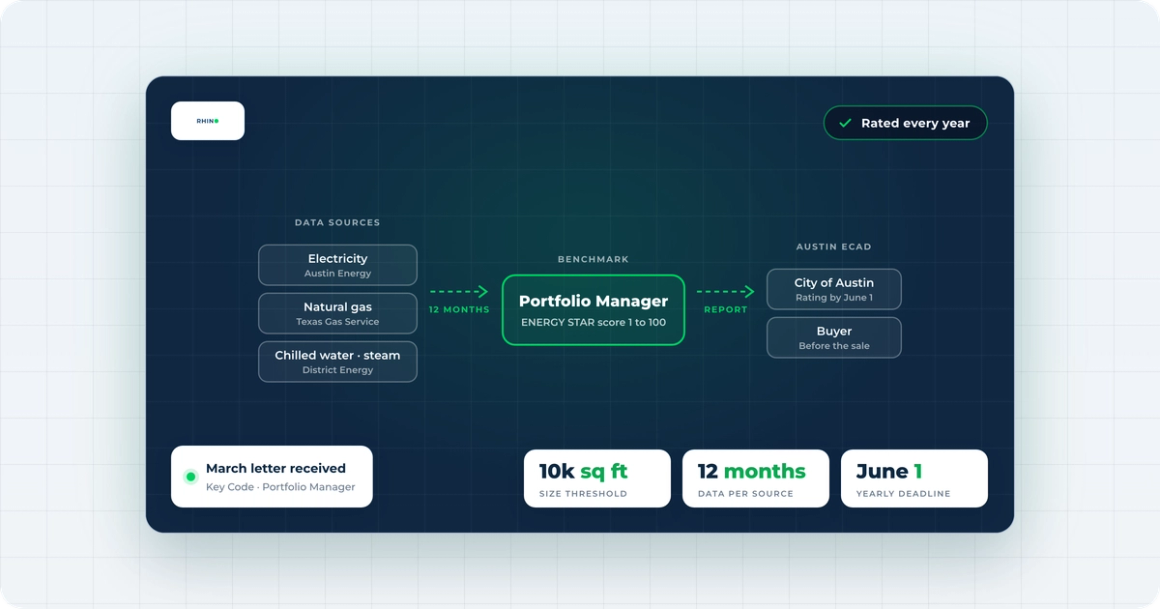
Austin Energy mails compliance letters to covered owners each March. By June 1, the owner reports a rating through one of two routes, both described on Austin Energy's ECAD page for commercial buildings.
| Route | How the rating is calculated | What the owner has to do |
|---|---|---|
| Key Code reporting | Austin Energy calculates energy use from its own electricity data and compares the building with others in its service area. | The owner checks the property details in the March letter and confirms them online with the letter's unique Key Code. |
| ENERGY STAR Portfolio Manager | Portfolio Manager calculates an ENERGY STAR score from 1 to 100 and an energy use intensity, compared with similar buildings nationwide. | The owner enters at least 12 months of data for every energy source the building uses and reports through Portfolio Manager. |
Both routes satisfy the ordinance. Key Code is the right choice for a building where compliance is the only goal, because it needs no data gathering at all. Portfolio Manager is the route for owners who want a nationally comparable score, who plan to sell, or who want ENERGY STAR certification, which requires a Portfolio Manager score of 75 or higher.
What goes into Portfolio Manager for ECAD?
Portfolio Manager needs basic property information, such as gross floor area and property type, plus at least 12 months of consumption for every energy source. In Austin that means a separate request for each source, as Austin Energy's Portfolio Manager guidance sets out.
| Energy source | Where the data comes from | What the owner has to request |
|---|---|---|
| Whole-building electricity | Austin Energy supplies it as a data report. | With three or fewer tenants, the owner needs a signed release form from each tenant. With four or more tenants, the owner can file an aggregation request, as long as no single tenant uses more than 80% of the total. |
| Natural gas | Texas Gas Service supplies it for the buildings it serves. | The owner requests the account history directly from Texas Gas Service. |
| Chilled water and steam | Austin Energy's District Energy team supplies it for connected buildings. | The owner emails a separate request to District Energy. |
Missing data does not move the deadline. Austin Energy states that reporting is still required even when a building does not have 12 consecutive months of data.
Where do ECAD filings get stuck?
Almost never on the rating itself. Filings stall on missing signatures and missing months, and those tend to surface in May.
A tenant release that never comes back. In a building with three or fewer tenants, one unsigned form holds up the whole-building electricity data.
One dominant tenant. Aggregation only works when no single tenant uses more than 80% of the building's energy. A large anchor tenant sends the owner back to individual releases.
A missing month. A gas bill lost in an inbox, or a meter swap mid-year, leaves a gap that has to be found and filled before the rating means anything.
Floor area that doesn't match. The gross floor area in the March letter, in Portfolio Manager and in the lease records often differs, and the rating moves with it.
A sale. The owner must give the rating to the buyer before the sales contract is executed, and send Austin Energy a copy within 30 days of completing it (section 6-7-32). A building that skipped a year has nothing ready to hand over.
How should you read your ECAD rating?
The ENERGY STAR score runs from 1 to 100 and compares a building with similar buildings nationwide: 50 represents median performance and 75 or higher marks a top performer, as EPA explains. ECAD does not require upgrades. The Austin City Council has set voluntary goals instead, published on Austin Energy's rating guide.
| If the ENERGY STAR score is | The City's voluntary goal is |
|---|---|
| 75 or higher | The owner applies for ENERGY STAR certification. |
| 63 to 74 | The owner raises the score to at least 75. |
| 42 to 62 | The owner raises the score by 20%. |
| Below 42 | The owner raises the score to 50. |
A worked example: an office scoring 55 falls in the 42 to 62 band, so its voluntary goal is a score of 66. Austin Energy also recommends looking for efficiency improvements whenever a building ranks below 50, and offers commercial rebates to help pay for them.
What happens if you miss the ECAD deadline?
Not reporting is a criminal offense under section 6-7-42 of the City Code. Each violation is a separate offense, with a fine of up to $500, or up to $2,000 where the owner acted with criminal negligence. The record owner of the property is presumed responsible (section 6-7-41), so the obligation stays with the owner even when a manager or consultant does the filing.
How does automated meter data remove the yearly ECAD scramble?
The ECAD effort is not the filing. It is collecting twelve months of data from several suppliers and tenants, once a year, against a deadline. Rhino moves that collection out of spring and into the meters.
Rhino reads electricity, gas, water and heat, including tenant submeters, through existing smart meters or Rhino's own hardware, which is FCC certified for the US. Each building gets one consumption history at 15-minute intervals, and monthly totals are built from measured data, ready to load into ENERGY STAR Portfolio Manager.
Two things change. A missing month shows up the week it happens, not in May. And because the data is measured per meter, you can see why a score is low, such as after-hours HVAC or one tenant's load, and fix it before the rating lands on a buyer's desk.
The honest limit: if Key Code is enough for your building, you don't need any of this. Rhino also does not file the rating for you; the owner or their energy professional still reports to the City. Automated data earns its place where you report through Portfolio Manager every year, run several buildings in Austin, or plan to sell. See how Rhino supports ESG and compliance reporting across a portfolio.
Frequently asked questions
When is the Austin ECAD report due?
The Austin ECAD report is due by June 1 every year. Austin Energy mails compliance letters to owners of covered commercial buildings each March, with the property details on file and the reporting options. An owner who did not receive a letter is still covered and can contact the ECAD help desk at Austin Energy. Each yearly rating must be completed in the calendar year it is due.
Do industrial buildings have to comply with Austin ECAD?
Yes, unless the building qualifies for the manufacturing exemption. Industrial and warehouse buildings of 10,000 sq ft or more that get their electricity from Austin Energy report like offices. Only a building whose use meets the Texas sales tax exemption for manufacturing, and whose account holder has a Predominant Use Exemption on file with Austin Energy, is exempt from the yearly rating.
Should I use Key Code or Portfolio Manager for ECAD?
Both routes satisfy the Austin ECAD ordinance. Key Code is faster: Austin Energy calculates the rating from its electricity data and the owner confirms the property details online. Portfolio Manager needs at least 12 months of data for every energy source, including natural gas and district energy, but gives a nationally comparable ENERGY STAR score and opens the route to ENERGY STAR certification.
What is the penalty for missing the ECAD deadline?
Not reporting is a criminal offense under Chapter 6-7 of the Austin City Code. Each violation is a separate offense, with a fine of up to $500, or up to $2,000 where there is criminal negligence. The record owner of the property is presumed responsible, so the obligation stays with the owner even when a property manager or consultant does the filing.
Do I have to share the ECAD rating when I sell a building in Austin?
Yes. The owner must give the buyer or prospective buyer the building's energy rating before the sales contract is executed, and send Austin Energy a copy within 30 days of completing the rating. If the building has not yet been rated, the seller is responsible for rating it, reporting it to Austin Energy and disclosing it to potential buyers.