US building performance standards stop asking owners to report and start charging them for missing a limit. Between 2026 and 2031 the first penalties land in most of the cities and states that have adopted one, and the meter data that decides each bill is being recorded now.
This post sets out the timeline year by year: when each program starts charging, what it charges, and which year's data it looks at. For the program-by-program detail, see our guide to US building performance standards.
What is a building performance standard?
A building performance standard (BPS) is a law that requires existing buildings to meet a set level of energy or emissions performance, and that level tightens over time. A benchmarking law only asks owners to report their energy use. A building performance standard sets a limit and attaches a fine or an alternative compliance payment to missing it.
How do building performance standard penalties work?
Every program measures one of three things: energy use per square foot (energy use intensity, EUI), greenhouse gas emissions, or the ENERGY STAR score. The penalty then takes one of three shapes. Some programs charge per metric ton of carbon dioxide equivalent (tCO2e) above the limit, every year. Some charge per square foot of floor area, whatever the size of the miss. Washington, DC charges an alternative compliance payment that scales with floor area and shrinks with the progress a building has made.
The difference matters. A per-ton penalty grows with the size of the miss. A per-square-foot penalty is close to all or nothing.
| How the program charges | What that means for a 100,000 sq ft office |
|---|---|
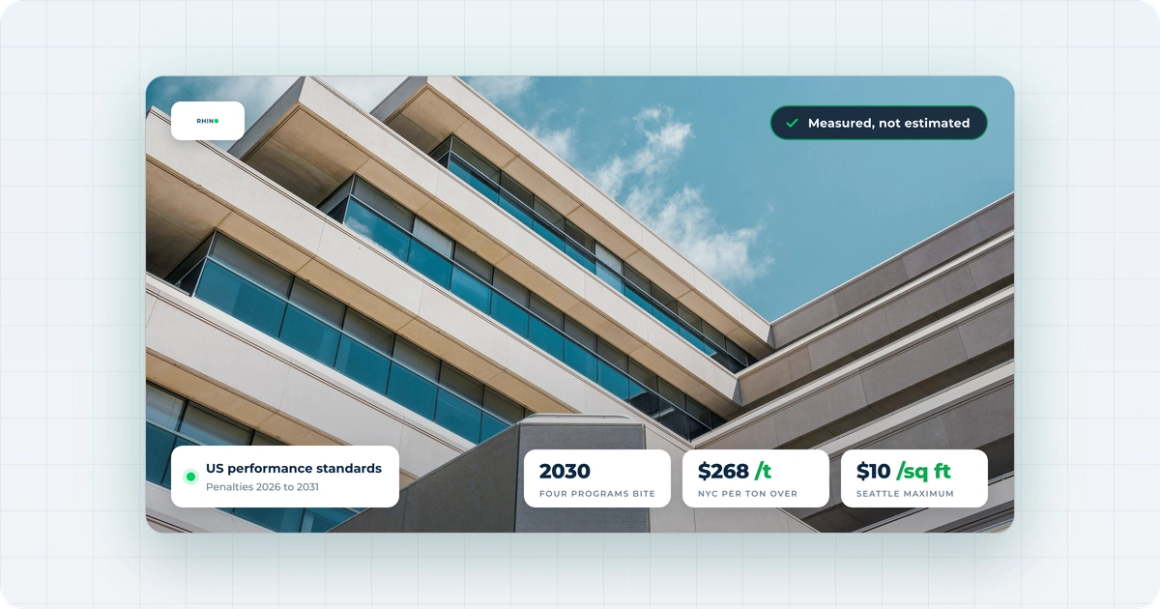
| New York City charges $268 per tCO2e above the limit, every year. | A building 300 tCO2e over its limit pays $80,400 for that year. |
| Boston charges an alternative compliance payment of $234 per tCO2e, every year. | The same 300 tCO2e miss costs $70,200 for that year. |
| Seattle charges up to $10 per sq ft for a non-residential building that misses a target, once per five-year interval. | Missing the target by any margin can cost up to $1,000,000. |
| Washington State charges up to $5,000 plus $1.50 per sq ft, according to the state Department of Commerce. | A building that misses its target can face a penalty of up to $155,000. |
These are maximums or list rates. Each program has exemptions, adjustments and appeal routes, so treat the table as the order of magnitude, not a quote.
The building performance standards penalty timeline, 2026 to 2031
Each program phases in by building size, so the largest buildings go first. New York City and Boston already apply limits: New York from 2024 and Boston from 2025 for its largest buildings. The rest arrive in this window.
| Year | What starts that year |
|---|---|
| 2026 | Washington State's first deadline passed on June 1 for Tier 1 buildings over 220,000 sq ft. Washington, DC's first compliance cycle ends on December 31 for private buildings over 50,000 sq ft. Cambridge, Massachusetts requires non-residential buildings over 100,000 sq ft to cut emissions 20% in the 2026 to 2029 period. |
| 2027 | Washington State's deadline moves to buildings of 90,001 to 220,000 sq ft on June 1, and Tier 2 reports are due on July 1. Seattle's first verified emissions reports for buildings over 90,000 sq ft are due on October 1. |
| 2028 | Washington State reaches buildings of 50,001 to 90,000 sq ft. Oregon's first deadline applies to buildings of 200,000 sq ft and up on June 1. Montgomery County, Maryland sets its first interim standards on December 31. |
| 2029 | Washington, DC is due to set its next standards by January 1. Oregon reaches buildings of 90,000 to 200,000 sq ft. Denver says it will not levy performance penalties before late 2029. |
| 2030 | New York City's limits tighten sharply. Boston's buildings of 20,000 to 35,000 sq ft join. Colorado's performance penalties can start on January 1. Maryland's first standard applies: 20% below the 2025 average emissions of similar buildings. |
| 2031 | Seattle's first emissions targets apply to buildings over 220,000 sq ft, with smaller buildings following each year to 2035. |
Two programs moved in 2025 and 2026. Colorado made its 2026 target optional in 2025: owners can meet it or report progress through benchmarking, and enforcement starts with the 2030 standard. Denver amended Energize Denver in 2026, cut its penalties roughly in half and reduced the number of deadlines. Timelines in this field change often, so check the official program page before you plan around a date: New York City, Boston, Washington State, Washington, DC, Seattle, Denver, Colorado, Maryland, Oregon and Cambridge.
Why is 2030 the year most portfolios should plan for?
2030 is when New York City's limits drop, Boston brings in its smaller buildings, Colorado starts fining, and Maryland's first standard applies, all in the same year. A portfolio with buildings in more than one of these places meets four programs at once.
New York is the clearest case. The 2030 limits are roughly half of the 2024 limits for most office buildings, so a building that passes today with room to spare can be over the line in 2030 without anything changing in the building. Our post on NYC Local Law 97 and 88 covers the New York rules in detail.
Which year's meter data decides the penalty?
The data that decides a penalty is collected years before the bill arrives. New York's 2030 emissions are reported by May 1, 2031. Boston's 2025 emissions were reported by May 15, 2026, and the first compliance year has to be verified by a third party. Maryland's 2030 standard is set against 2025 emissions of similar buildings, and Colorado's targets are measured against 2021.
So the years between now and the first deadline do two jobs. They write the record a building will be judged against, and they are the only time left to cut before the penalty starts counting. A gap in 2027 data is a problem in 2030, when nobody can go back and read the meter.
When is a spreadsheet good enough?
For one building with one owner-paid electricity account and one gas account, it often is. Many US utilities can send whole-building monthly totals straight to ENERGY STAR Portfolio Manager, which every program on this list uses for reporting. If that building is far below its limit, annual reporting from utility bills meets the requirement.
It stops being enough in three situations. When tenants pay their own utilities and the owner still answers for the whole building. When the portfolio spans several cities, each with its own deadline, metric and verifier. And when a building is close to its limit, because a yearly total tells you that you are over, not why.
How Rhino helps building owners prepare
Rhino reads every meter automatically: electricity, gas, water and heat, including tenant submeters. Each building gets a measured, complete record with timestamped readings, which is what a third-party verifier checks in Boston, Seattle and Maryland.
The same dataset serves every city in the portfolio. Monthly totals per meter can be exported for ENERGY STAR Portfolio Manager, and the Rhino API sends the data to your ESG reporting tools. Interval data shows where a building wastes energy: HVAC running after hours, plant that never switches off, a tenant whose load has doubled. Those are the cheapest tons to remove, and a monthly bill never shows them. Our post on 15-minute interval data explains what that resolution shows.
Rhino does not file your compliance report or replace the registered professional who signs it. It makes sure the numbers they sign are complete and measured.
Frequently asked questions
When do building performance standard penalties start in the US?
It depends on the program and the building size. New York City and Boston already apply limits. Washington State's first deadline passed on June 1, 2026. Washington, DC's first cycle ends on December 31, 2026. Colorado and Maryland start in 2030, and Seattle's first targets apply in 2031. Denver says it will not levy performance penalties before late 2029.
How much is the fine for missing a building performance standard?
It ranges from a per-ton charge to a flat amount per square foot. New York City charges $268 per metric ton of CO2e over the limit each year, and Boston $234. Seattle charges up to $10 per square foot for non-residential buildings that miss a target. Washington State lists up to $5,000 plus $1.50 per square foot.
Why do so many building performance standards tighten in 2030?
Most programs were written around 2030 climate goals. In 2030 New York City's emissions limits drop sharply, Boston adds buildings of 20,000 to 35,000 square feet, Colorado can start fining, and Maryland's first emissions standard applies. A portfolio with buildings in several of these places faces new limits in all of them in the same year.
Which data year counts for a building performance standard?
Each program judges a building on data recorded well before the bill. New York reports each calendar year's emissions by May 1 of the following year. Maryland sets its 2030 standard against 2025 emissions of similar buildings, and Colorado measures against 2021. Data that is missing or estimated today becomes a compliance problem in 2030.
Rhino gives ESG teams measured data for every utility in every building, wherever it sits. See how Rhino supports ESG and compliance reporting.