GRESB plans to make its 2028 Real Estate Standard the first one that scores mainly on how buildings perform, not on what portfolios disclose. The GRESB 2028 assessment covers calendar year 2027, so the data behind your first performance-weighted score starts on 1 January 2027. Readings you miss in 2027 cannot be added in 2028.
This post explains what the GRESB Foundation proposed for 2028, which proposals its July 2026 consultation findings kept and which are still open, why data coverage still decides whether an asset gets scored, and what to put in place before 1 January. Every 2028 point figure below is a consultation proposal. The final methodology is due in Q4 2026.
What is the GRESB Road to Performance?
The Road to Performance is the GRESB Foundation's plan to move the GRESB Real Estate Standard from rewarding disclosure to rewarding measured results. Its first implementation is the 2028 Standard, which assesses 2027 data. After that, GRESB proposes fewer but larger changes on a three-year cycle, with indicative iterations in 2031 and 2034. Energy and greenhouse gas (GHG) emissions are the first topics to get more performance weight, as GRESB's announcement on reshaping the Real Estate Standard sets out.
How does GRESB score energy today?
The GRESB score runs from 0 to 100 points, so one point is one percentage point of the total. In the 2026 Standard, combined energy and GHG performance is worth about 6% of the score, according to the Road to Performance consultation paper. For operational energy, indicator EN1 in the 2026 GRESB guide gives 8.5 points for data coverage and 2.5 points for energy performance.
The performance points come either from being efficient or from improving like-for-like. The efficiency route has strict entry conditions: at least 355 days of data, a vacancy rate below 20%, energy data coverage of 75% or more, and an energy use intensity (EUI) below the threshold in ASHRAE Standard 100:2024. An asset that misses one condition gets no efficiency score.
So today most energy points reward collecting data, not using less energy. The 2028 proposals are built to turn that around.
What changes in the GRESB 2028 Real Estate Standard?
The consultation proposed putting a quarter of the GRESB score on energy and GHG performance, and paying for part of it by cutting the points for data coverage. The table compares today's scoring with the proposals and shows where each one stands after the July 2026 consultation findings.
| Which part of the score is it? | How does it work in the 2026 Standard? | What did the consultation propose for 2028? | Where does it stand after the July 2026 findings? |
|---|---|---|---|
| Energy and GHG performance | Combined performance scoring is worth about 6% of the score. | It rises to 25 points, with 14 for energy and 11 for GHG. | GRESB is refining the method so it accounts for region, asset type, lease structure and data access. |
| Energy and GHG data coverage | Energy data coverage is worth 8.5 points and GHG data coverage 5.0 points. | Energy coverage drops to 6.5 points and GHG coverage to 3.5 points, a combined cut of 3.5 points. | GRESB will reduce the standalone weight and fold data completeness into performance scoring, and is reconfirming the details. |
| Third-party data review | Review of energy and GHG data is worth about 3 points. | It rises to 4.0 points for energy and 3.25 points for GHG, 4.25 points more in total. | GRESB will give data quality more weight, but as part of performance scoring rather than as a separate score. |
| Foundational indicators | Management indicators earn points like any other indicator. | 17 indicators worth about 18 points become prerequisites, and an entity below the 80% threshold gets a score but no GRESB Rating. | GRESB found that about 86% of entities already meet the threshold, and is reconfirming the design. |
| The 75% coverage minimum | Absolute performance scoring needs at least 75% energy data coverage. | The minimum stays in place. | Respondents called it a reasonable minimum, and GRESB is working on rules for tenant-controlled assets. |
Two parts of the plan are settled: the staged three-year cycle and energy and GHG as the first focus. The 2028 date itself is marked for reconfirmation. In the consultation, 64% of respondents supported it and only 16% said they felt prepared, yet GRESB named 2028 as the balance between urgency and feasibility and still expects to publish the final updates in Q4 2026.
Why does data coverage still matter if it earns fewer points?
Data coverage becomes the entry ticket, not the prize. An asset below 75% energy data coverage cannot earn absolute performance points, and that is where the new weight goes. The proposal takes 3.5 points away from coverage and moves performance from about 6 points to 25.
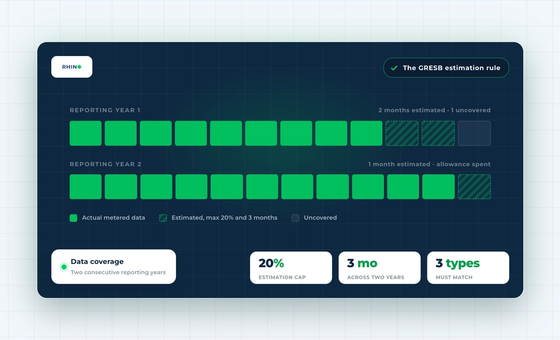
A portfolio that keeps coverage high gives up a few coverage points and gets access to the performance points. A portfolio that lets coverage slip loses both. Coverage also has to be real: estimated data only counts within limits, as our post on how much estimated data you can use in GRESB explains.
Which 2027 data decides your first GRESB 2028 score?
The first performance-weighted score rests on a full calendar year of measured energy and emissions data for each asset. Six things make the difference.
Whole-building energy, tenant space included. GRESB measures energy data coverage by floor area and time. A tenant floor without data lowers coverage for the whole asset.
Actual readings, not estimates. Measured data holds up in third-party review. Estimates fill gaps, but they are capped and they weaken the audit trail.
A full year for every asset. Efficiency scoring today needs at least 355 days of data. A meter connected in March 2027 costs that asset its first quarter.
The split by fuel and source. The consultation paper defines GHG performance as reductions beyond energy use alone: fuel switching, on-site renewable generation and renewable procurement. You need to know which energy came from which source.
An audit trail a reviewer can follow. Third-party review is set to weigh more. A reviewer has to trace every reported number to a meter, a period and a data source.
A clean baseline for improvement. Like-for-like scoring compares the same assets year on year, so 2027 also becomes the baseline for 2028. Our guide to measuring energy savings with before-and-after meter data covers how to set one up.
What should a portfolio do before 1 January 2027?
Five steps between now and the end of December put the 2027 data year on a measured footing.
| Which step is it? | What should be done? | Why does it matter for GRESB 2028? |
|---|---|---|
| 1. Map coverage per asset | List each asset's floor area, which areas have measured energy data, and which rely on estimates or have no data at all. | Coverage is measured by floor area and time, so you need the gap in square meters before you can close it. |
| 2. Connect the missing meters | Start with the tenant and landlord meters that keep an asset below 75% coverage. | An asset below 75% coverage cannot earn absolute performance points. |
| 3. Replace estimates with readings | Switch estimated and invoice-based values to remote meter readings wherever the meter allows it. | Measured data survives third-party review, and estimated data is capped. |
| 4. Set up review-ready records | Keep a meter register with serial number, location, asset and data source, and log every correction. | A reviewer has to trace each reported number back to its source. |
| 5. Baseline intensity per asset | Calculate each asset's 2026 energy use intensity and compare it with the ASHRAE 100:2024 threshold for its type. | You find the assets that will pull the score down while there is still time to act. |
None of these steps requires 15-minute data. A portfolio with complete, actual monthly readings for every asset can score well under the proposals. 15-minute interval data helps you find where the savings are, but GRESB scores the annual result.
Better data does not earn performance points by itself either. The buildings still have to use less energy and emit less. What good data does is make sure every improvement you make gets counted.
Where does Rhino fit in GRESB 2028 preparation?
Rhino collects utility data automatically for all utilities, electricity, gas, water and heat, including tenant submeters. It connects through smart meters and utility APIs where it can, and through Rhino hardware where a meter cannot be read remotely. Data arrives at 15-minute intervals and lands in one dataset per asset, ready to feed the ESG reporting platform you already use.
Rhino is not a GRESB reporting tool. It is the data layer underneath, so the coverage, the actual readings and the audit trail exist before reporting starts.
Frequently asked questions
When does GRESB switch to performance-based scoring?
GRESB plans to switch with the 2028 Real Estate Standard, which assesses calendar year 2027 data. In its July 2026 consultation findings, the GRESB Foundation named 2028 as the balance between urgency and feasibility, and it expects to publish the final methodology in Q4 2026. After 2028, GRESB proposes major changes on a three-year cycle, with indicative iterations in 2031 and 2034.
How many points will energy and GHG performance be worth in GRESB 2028?
The consultation proposed 25 of the 100 GRESB points: 14 for energy performance and 11 for greenhouse gas (GHG) performance, up from about 6% of the score today. These are proposals. The July 2026 findings say GRESB is still refining the method for region, asset type, lease structure and data access, and the final numbers are due in Q4 2026.
Does data coverage still count in GRESB 2028?
Yes, but it is set to earn fewer points. The consultation proposed cutting energy data coverage from 8.5 to 6.5 points and GHG data coverage from 5.0 to 3.5 points. The 75% energy data coverage minimum for absolute performance scoring stays, so an asset below 75% cannot earn the performance points that carry the new weight.
Which data year does the GRESB 2028 assessment use?
The GRESB 2028 assessment uses data from calendar year 2027, from 1 January to 31 December. Energy readings that are missing or estimated during 2027 cannot be replaced with measured data afterwards. Portfolios that want a strong first performance-weighted score need their meters connected and reporting by 1 January 2027.
Are the GRESB 2028 changes final?
No. The July 2026 consultation findings confirm the direction but not the numbers. GRESB will proceed with the staged three-year model and with energy and GHG as the first focus. The point weights, the coverage cut, the prerequisites and the 2028 timing are still being refined or reconfirmed, and the final updates are due in Q4 2026.
Start with the coverage gap
The assets that will struggle in GRESB 2028 are the ones that enter 2027 below 75% coverage or on estimated data. See how Rhino supports ESG and compliance reporting with measured data for every asset.