
 ×
×

Recogizer optimizes. Rhino proves it.
Recogizer's energyControl writes AI-optimized setpoints into your building's systems every 15 minutes, through the BMS. Rhino reads the meters on the same 15-minute cadence, independently, and measures what changed. One system runs the building. The other counts the result. That separation is what makes the savings figure auditable.
How they fit together
Two jobs. Kept separate on purpose.
Recogizer is the control layer. Its gateway reads equipment, sensors, weather and occupancy, calibrates against your comfort and performance targets, and writes optimized instructions back into the BMS every 15 minutes. That loop runs on its own, around the clock.
Rhino is the measurement layer. It connects to the meters in the building, across all utilities and down to submeter level, and reports what was actually consumed, at 15-minute intervals. It sits outside the control loop and reads the meter, not the BMS.
Two systems, one cadence. The separation is deliberate: when the measurement comes from a meter read by a different party, the savings figure carries its own evidence. One company produced the result, another counted it. That is the form an auditor, a lender or an investment committee wants it in.
What Rhino brings
The independent measurement the savings figure rests on
- Measures from outside the control loop. Rhino reads the meter, not the BMS, over its own connection. The measurement and the optimization travel separate paths, which is what makes the result independent.
- All utilities, not just electricity. HVAC optimization moves load between electricity, gas and heat. Read one meter and you can miss a shift entirely. Rhino reads all of them, at 15-minute intervals.
- Submeter and equipment-level granularity. Tenant and circuit-level submeters mean a saving traces back to the equipment that produced it, not just to the building.
- A metered baseline instead of a modeled one. Where a building has no smart metering, the fallback is a benchmarking model with contract pricing. Rhino connects to the meters already in the building and replaces the estimate with a reading.
- One dataset across the portfolio. The same structure in every asset, whether or not Recogizer is deployed there.
- Validated before it counts. Gaps and anomalies are flagged at ingest, so a metering fault never quietly reads as a saving.
What Recogizer brings
Everything that happens to the building itself
- Acts on the building. Recogizer's gateway writes AI-optimized setpoints directly into the BMS and actively manages heating, cooling and ventilation. Acting on the building is Recogizer's job, by design, and only Recogizer's.
- Reads the building, not just the meter. Temperature, CO₂, occupancy, equipment on/off status and weather, ingested and analyzed together against your comfort and performance targets.
- Learns the building over a full year. Models improve with every summer cooling, shoulder-season and winter heating cycle, and are built for that building rather than a building type.
- Holds comfort as a constraint. Consumption comes down without tenants noticing, because comfort and savings targets are set per building and per tenancy.
- Protects equipment life. Fan speeds and setpoints step up and down instead of equipment switching fully on and off, which avoids the wear that hard cycling causes.
- Carries the compliant optimization. energyControl is independently confirmed by TÜV Rheinland. The German building automation obligation it serves now sits in GModG § 56. Rhino supplies the metered consumption underneath the reporting.
Each half does a job the other one does not. Put them together and a building's energy performance becomes an operating result: less consumption, in kWh and in euros, traceable to a meter ID and a timestamp, produced by one company and counted by another. That reduction lands in operating cost for tenants and in NOI for owners.
How it runs
One loop controls. One layer counts.
Recogizer's control loop runs every 15 minutes without anyone touching it. Rhino's measurement runs alongside it, connected to the meter rather than to the building.
Recogizer
Control loop, every 15 minutes
1
Read the building
Live readings from sensors and equipment, plus weather and occupancy, taken in through Recogizer's own gateway.
2
Calibrate
The AI weighs current conditions against your comfort and performance targets, and works out what the equipment should be doing instead.
3
Write back to the BMS
Optimized setpoints go into the building's own systems. No manual intervention, no request queue, no operator in the loop.
4
Equipment responds
Heating, cooling and ventilation adjust. Consumption changes. That change is what Rhino measures next.
Rhino
Measurement layer, continuous and independent
Meter-level consumption
Electricity, gas, water and heat, plus submeters, at 15-minute intervals, read straight from the meter through utility network connections or on-site hardware.
Outside the control loop
No path into Recogizer's setpoints. Rhino measures the outcome, it does not influence it. That is what makes the verification independent rather than internal.
Validated at source
Gaps and anomalies are flagged before the data is used for anything, so a metering fault never quietly reads as a saving.
Rhino is not in the control loop. That is the point. No system can independently verify its own output. Recogizer compares actual metered consumption to a calibrated baseline built from thousands of data points from that specific building, and reports the result in kWh, euros and tonnes of CO₂.
energyControl in action
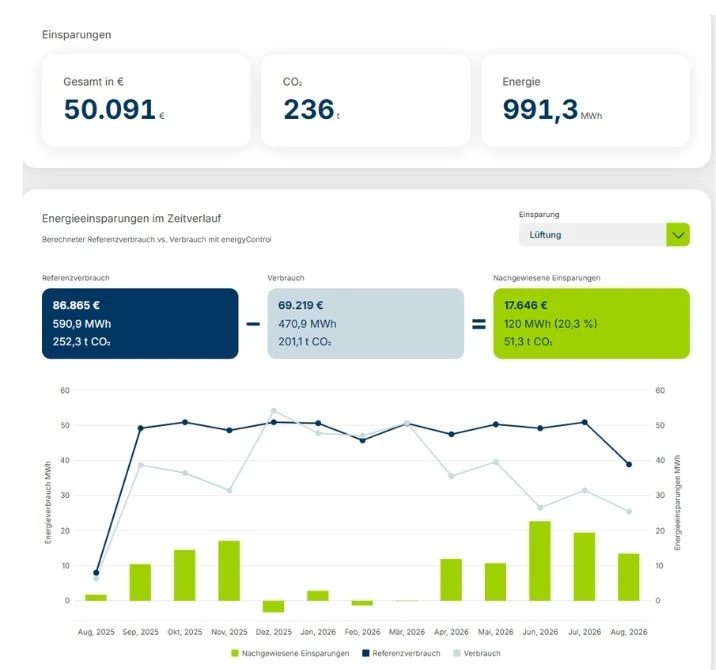
Reference consumption against what the building actually used.
Recogizer builds a reference consumption baseline for the building, then holds actual metered consumption against it, period by period. The difference is the verified saving.
Because the consumption side comes from Rhino's meters rather than an estimate, the gap between the two lines is a measurement, not a projection. Anything the model cannot attribute, an equipment fault for example, is called out separately instead of being quietly booked as a saving.
20.3%
Verified reduction
120 MWh
Energy saved
51.3 t
CO₂ avoided
Ventilation scope, single building. Verified against metered consumption, not modeled. Client and site not disclosed.
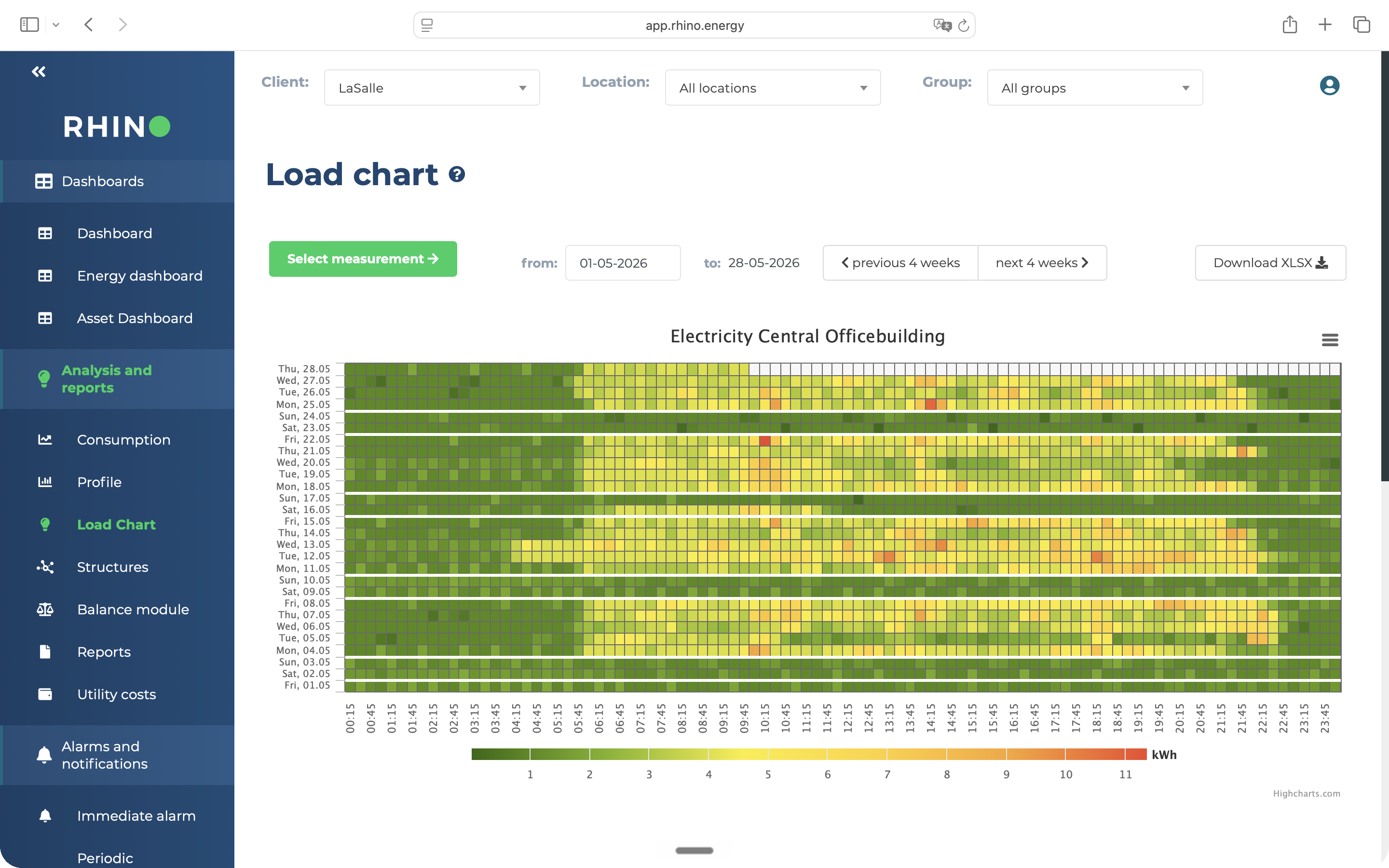
Rhino. The 15-minute metered consumption behind the number: independent of the optimization, traceable to a meter ID and a timestamp.
What it delivers
Savings you can put in a report and defend.
Recogizer's optimization is strong on its own. What Rhino adds is a number that holds up when somebody checks it.
A number that survives scrutiny
Every reduction traces back to a meter ID and a timestamp. The party that changed the building is not the party that measured the result, which is the first question an auditor, a lender or an investment committee asks.
All utilities, so nothing hides
Optimizing HVAC shifts load between electricity, gas and heat. Measure only electricity and a shift can read as a saving. Rhino reads all of them, so the number reflects total energy, not one meter's view of it.
A metered baseline, not a modeled one
Without smart metering, savings calculations fall back to benchmarking models and contract prices. Rhino connects to the meters already in the building and replaces the estimate with a reading, which turns a savings report from an argument into a record.
Equipment-level traceability
Submeter and circuit-level data shows which equipment produced the saving. That turns a portfolio-wide percentage into something an operations team can act on and repeat in the next building.
Compliance and asset value, not just cost
Verified consumption and carbon data feeds EPBD-driven performance work, CSRD reporting, green building certification and stranded asset risk. Lower energy cost lands in NOI. The verification is what lets you claim any of it.
Portfolio-wide, low CAPEX
Rhino connects to the meters already in each building, software-first and hardware only where needed. Rolling verified measurement across an estate does not require a metering overhaul.
About Recogizer
AI for green buildings, proven at scale.
Recogizer's energyControl autonomously and verifiably reduces a commercial building's energy consumption and carbon footprint without compromising tenant comfort, turning energy efficiency from an untapped opportunity into an NOI-improving outcome.
Based in Bonn, Recogizer builds self-learning building solutions that cut energy use, emissions and operating costs. Two products carry the platform: energyControl, the autopilot that manages HVAC performance directly, and energyAdvisor, the navigator that surfaces concrete optimization recommendations. Apleona is the main shareholder.
Visit recogizer.com5M+ m²
Under active management
Commercial properties optimized by Recogizer's AI
10
European countries
Deployed across offices, retail, shopping centres, and hotels
10+ years
In market
A pioneer of self-learning building optimization
ISO 27001
Certified IT security
Independently certified information security standard
Built for GModG § 56, confirmed by TÜV Rheinland
Recogizer's energyControl is independently confirmed by TÜV Rheinland. Germany's building automation obligation moved into GModG § 56 in July 2026: non-residential buildings above 70 kW must run building automation that monitors energy use, by 31 December 2029. Rhino provides the independent metered consumption data behind it.
Read the GModG guideOptimizing a building is only half the job. You also have to be able to prove what it achieved. Our partnership with Rhino gives us the independent, equipment-level data to quantify exactly how much energy and cost our building optimization saves. That's the kind of concrete, defensible evidence our customers deserve.

Carsten Kreutze
CEO and Co-Founder, Recogizer
Recogizer runs the building. Rhino reads the meters. Neither of us grades our own homework, and that is exactly why the savings figure holds up when a lender or an auditor asks where it came from.

Xander van Baarsen
GM, Rhino
Common questions
Recogizer x Rhino, answered.
Recogizer's AI optimizes heating, ventilation and cooling by writing setpoints into your building's BMS every 15 minutes. Rhino connects to the meters in the same building, across electricity, gas, water and heat plus submeters, and measures what that optimization actually changed. Recogizer holds that metered consumption against a calibrated baseline and reports the saving in kWh, euros and tonnes of CO₂.
Not into the control loop. Recogizer reads the building itself, through the BMS and its own gateway, taking in equipment, sensor, weather and occupancy data. Rhino's metered consumption goes into the measurement and verification layer, where savings are calculated against the baseline. Keeping Rhino out of the control loop is deliberate: it is what makes the verification independent.
Because the measurement has to stand on its own. When it comes from a separate party reading the meter directly, over a separate connection, the savings figure carries its own evidence and holds up in front of an auditor, a lender or an investment committee. Every reduction traces back to a meter ID and a timestamp.
Savings calculations fall back to a benchmarking model combined with contractual energy prices, which is a reasonable estimate and nothing more. Rhino connects to the meters already installed, through utility network connections or on-site hardware, and replaces that estimate with a reading. No meter replacement, no retrofit, low CAPEX.
Yes. Electricity, gas, water and heat, plus tenant and circuit-level submeters, at 15-minute intervals. That matters more here than on most integrations: HVAC optimization moves load between electricity, gas and heat, and measuring only one of them can make a shift look like a saving.
Recogizer acts on the building. Rhino measures it. Recogizer's AI controls heating, ventilation and cooling through the BMS and holds tenant comfort as a constraint. Rhino connects to the meters and reports actual consumption across all utilities. The two are complementary, not competing, and deliberately independent of each other.
Book a demo with Rhino. The team assesses your meter estate, works out the right connection path per building, and sets up the measurement feed. Most clients are live within weeks of onboarding.
Running Recogizer?
Put a metered number behind it.
Rhino connects to the meters already in your buildings and measures what the optimization delivers, independently. Book a demo and we'll assess your portfolio in the first session.
Further reading
From the Rhino blog.

