AI is now in every building energy pitch. Vendors promise HVAC that tunes itself, maintenance that predicts its own failures, and utility bills that shrink on their own. Some of it is real. The IEA estimates that scaling up existing AI-led optimization in buildings could save around 300 TWh of electricity globally, roughly what Australia and New Zealand generate in a year.
There's a catch that rarely makes the slide. AI doesn't run on algorithms. It runs on data. And in most buildings, the data is the weakest part of the whole system.
That is the part that decides whether AI saves you money or just adds another dashboard. Not the model. The feed underneath it.
AI is only as good as the data you feed it
"Garbage in, garbage out" is an old line, but AI made it expensive. A model doesn't correct bad inputs. It scales them. Feed it gaps and estimates and it will produce confident, wrong answers faster than any human could.
The starting point is not encouraging. Missing values show up in most real-world datasets, and building data is worse than most. An AI HVAC optimizer trained on a meter that drops half its readings is optimizing against fiction. It will still return a number. The number will just be wrong.
So before you ask "which AI," the real question is simpler: what is it reading, and can you trust it?
Building data is where it breaks
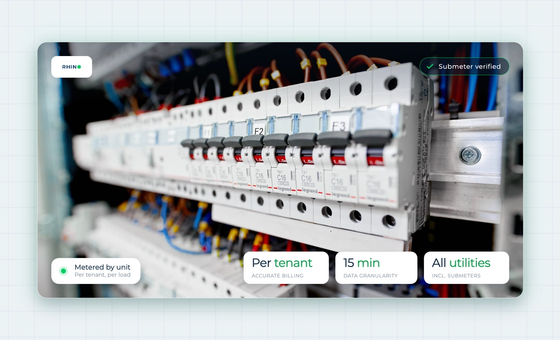
Buildings are one of the hardest places to get clean data. Consumption is spread across four utilities, electricity, gas, water and heat, across a main meter and a stack of submeters, often from different vendors and different decades. Some are read automatically. Many are still read by hand, or not at all.
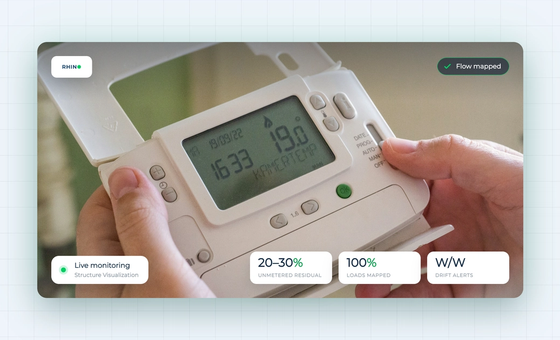
The result is exactly what AI can't use: irregular sampling, missing intervals, meters that drift out of calibration, and whole subsystems with no measurement at all. Add up every submeter in a typical building and the total rarely matches the main meter. That gap is energy you pay for but can't explain.
The IEA is blunt about why AI stalls in buildings: fragmented ownership, a lack of digitalization, and missing or inadequate access to data. You can put the smartest model in the world on top of a building. It still can't see what the meters never captured.
What AI actually needs from your building
Strip it back and every AI energy use case wants the same four things from the data underneath it:
Complete. Every utility and every submeter, not just the main electricity meter. Electricity, gas, water and heat.
Accurate. Measured, not estimated, and not corrupted by manual transcription along the way.
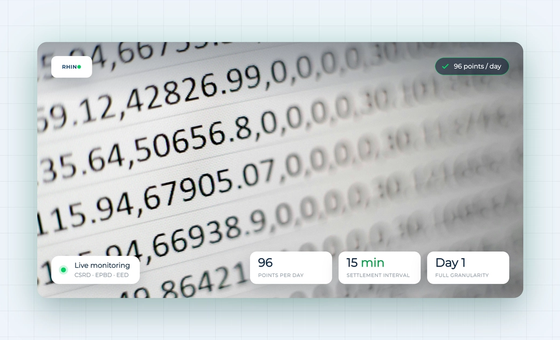
Granular. 15-minute interval data, not one read a month. 96 readings a day is what lets a model see patterns. One number a month hides them.
Continuous. A live feed, not a quarterly export. AI adjusts in real time or it doesn't adjust at all.
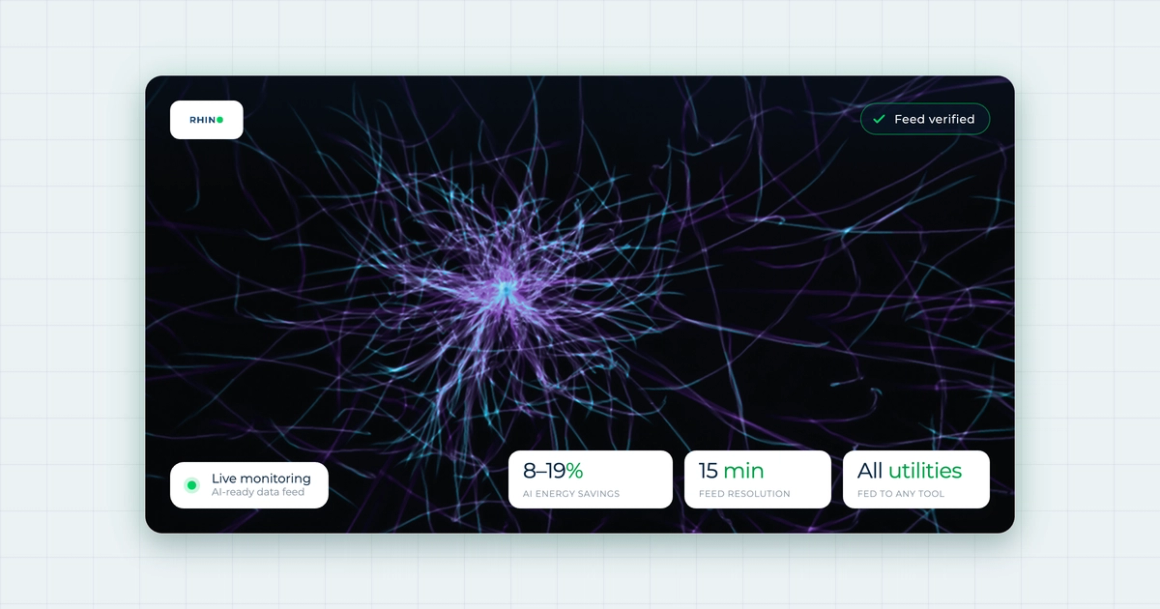
Get those four right and the familiar AI use cases actually work: HVAC that pre-cools before a heatwave, maintenance that flags a failing chiller before it fails, load shifting that dodges peak pricing, and forecasting that plans tomorrow's demand. Research puts the ceiling for AI-driven building systems at an 8 to 19% cut in energy and emissions. That ceiling is only reachable when the data lets the model see clearly.
See how the Utility Data API delivers one clean feed to any tool →
Rhino is the feed, not the AI
Here is where we're honest about what Rhino is and isn't.
Rhino doesn't sell AI. There's no black box here promising to run your building for you. What Rhino does is the unglamorous layer that AI depends on: collecting and automating utility data across your entire portfolio, electricity, gas, water and heat, down to the submeter, and turning it into one clean, continuous, 15-minute feed.
We connect to what's already in the building, through smart-meter connections or our own hardware, without ripping out infrastructure or waiting on a capital project. Software where it's available, hardware where it isn't. The output is the thing every AI tool, every BMS, and every ESG report is quietly starving for: data you can trust.
An AI is only ever as good as what it's fed. Rhino is the feed.
Before you buy the AI, fix the feed
One piece of practical advice. Before you sign for an AI energy tool, audit the data it will run on. Ask what meters it reads, how often, and what happens to the utilities and submeters it can't see. If the answer is thin, the results will be too.
AI in buildings is real, and it's worth doing. The IEA is equally clear that it's no silver bullet, and that the barrier is rarely the model. It's the data. Fix the feed first. It's the cheaper, higher-return move, and it makes every tool you add afterward, AI included, work better.
Ready to give your building data an AI can actually trust? Rhino turns your meters into one clean, real-time feed. Book a demo to see it on your portfolio.
Frequently asked questions
Does Rhino use AI?
No. Rhino is the data layer that AI runs on. We collect and automate accurate, complete utility data across your portfolio, which is what makes any AI, BMS or ESG tool sitting on top of it reliable.
Can AI really cut building energy use?
Yes, within limits. Studies point to an 8 to 19% cut in energy and emissions from AI-driven building systems, and the IEA estimates around 300 TWh of global savings potential. Those results depend entirely on the quality of the underlying meter data.
Why does data quality matter so much for AI?
AI scales whatever you feed it. Gaps, estimates and manual errors get amplified, not corrected. Complete, accurate, high-resolution data is the difference between an AI that saves money and one that just looks busy.
What data does an AI energy tool need?
Complete (all four utilities and submeters), accurate (measured, not estimated), granular (15-minute intervals), and continuous (a live feed). That is exactly what Rhino delivers.