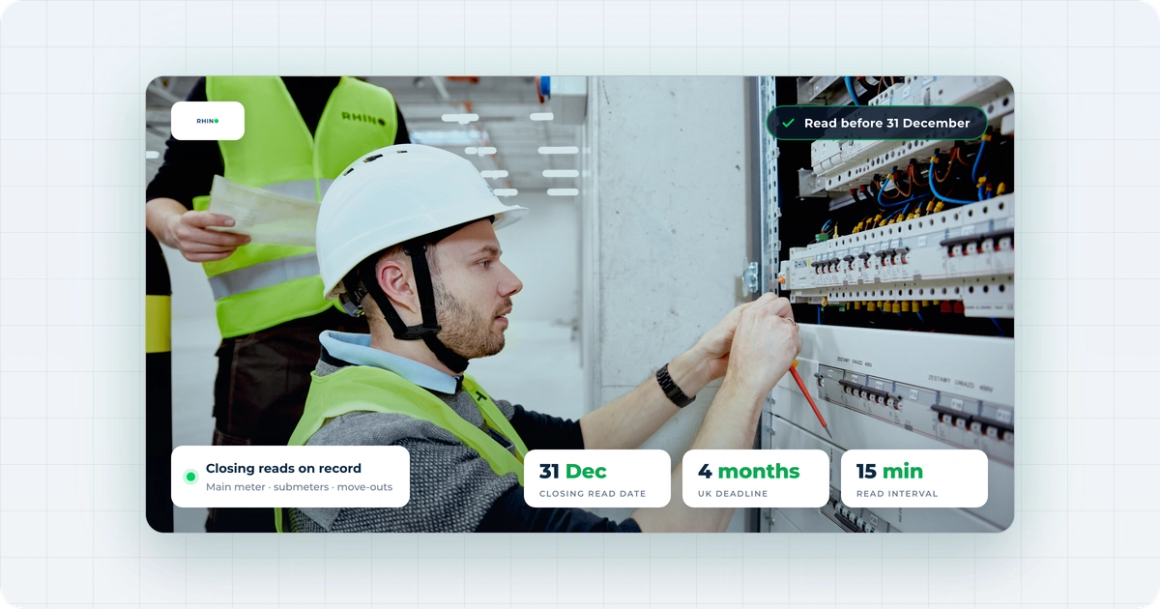
Your year-end utility recharge goes out months after 31 December, but whether it holds up is decided before that date. A meter reading nobody took on 31 December cannot be taken in February. It can only be estimated, and an estimate is the first thing a tenant challenges.
This post covers when the year-end statement is due in the UK, the Netherlands and Germany, the five data points you cannot rebuild after year end, and a checklist for October to December. It is about prevention. If a tenant is already challenging last year's figures, start with the data that settles a utility recharge dispute.
What is a year-end utility recharge?
A year-end utility recharge is the reconciliation in which a landlord compares what tenants paid on account for utilities during the service charge year with actual consumption and invoices, then charges or refunds the difference. It rests on three inputs: supplier invoices, meter readings at the start and end of the period, and a record of which meter serves which tenant. Invoices can be requested after year end. Readings and meter records mostly cannot.
When is the year-end service charge statement due?
The deadline depends on the country and the type of lease, and it always falls months after the data stopped being collectable. The statement is written in spring. The readings it relies on had to exist on 31 December.
| Which lease does this cover? | What sets the deadline? | When must the statement reach tenants? |
|---|---|---|
| This row covers commercial property in the UK. | The Royal Institution of Chartered Surveyors (RICS) standard on service charges in commercial property, 2nd edition, binds RICS members and RICS-regulated firms. | Year-end accounts must be issued within four months of the service charge year end, which is the end of April for a calendar year. |
| This row covers residential tenancies in the Netherlands. | Article 7:259 of the Dutch Civil Code (Burgerlijk Wetboek) sets the rule. | The landlord must provide an overview of service charges and individually metered utility costs within six months after the calendar year, broken down by type and showing how each amount was calculated. |
| This row covers residential tenancies in Germany. | Section 556 of the German Civil Code (Bürgerliches Gesetzbuch, BGB) sets the rule. | The operating cost statement must reach the tenant within twelve months after the end of the accounting period, or the landlord generally loses the right to claim an underpayment. |
| This row covers commercial leases outside these rules. | The lease itself sets the deadline, for example a lease based on the ROZ model (Raad voor Onroerende Zaken) in the Netherlands. | The date in each lease applies, so check the service charge clause rather than assuming a market norm. |
The UK deadline is in the RICS professional standard Service charges in commercial property, effective from 31 December 2025. The Dutch rule is article 7:259 of the Burgerlijk Wetboek, and the German rule is section 556 of the BGB.
The same RICS standard calls separate metering or full submetering of utility supplies essential for an apportionment that reflects actual consumption. That is a statement about data, and data has a calendar.
What cannot be reconstructed after 31 December?
Five data points either exist on the day or never exist. Everything else in the statement, including supplier invoices, can be chased after year end.
| Which data point? | Why can't it be recovered later? | What are you left with if it is missing? |
|---|---|---|
| The closing read on 31 December is the first. | A meter register keeps counting, so a read taken on 20 January includes 20 days of the new year. | You split the gap pro rata or by estimate, and the tenant can challenge the split. |
| The move-out read on the day a tenant leaves is the second. | The next occupier, a fit-out contractor or the empty unit's base load starts adding to the same register. | You divide consumption between two parties who both have a reason to dispute it. |
| The final read of a replaced meter is the third. | Unless someone records it at the swap, the old register leaves the building with the meter. | The year has a hole between the last recorded read and the new meter's first read. |
| Consumption history for a period nobody recorded is the fourth. | A meter that only shows a running total cannot tell you afterwards when the energy was used. | You can bill the total, but you cannot show a monthly pattern that proves it is plausible. |
| The meter to unit register as it stood during the year is the fifth. | A meter that moved to a different unit during a fit-out leaves no trace unless someone wrote it down. | You bill from today's mapping and assume it was the same all year. |
Some electronic meters keep a limited consumption history in their own memory. Check what yours store before assuming the data is gone, but do not plan a statement around it.
Dutch residential law shows why the move-out read matters. Under article 7:259, when a tenancy ends, the overview covers the part of the calendar year that has already passed. That overview needs a reading on the end date.
The October to December data checklist
Three months is enough to close most gaps, if the work starts in October. The order matters: you cannot schedule the right reads until you know which meters serve which tenants.
| When? | What should be in place? | Why does it matter for the statement? |
|---|---|---|
| Do this in October. | Check the meter to unit register against the current tenant schedule and the lease plans. | A wrong mapping found now is a correction, while one found by a tenant in spring undermines every other line. |
| Do this in October. | List every submeter that has not been read this year, and find out which can be read remotely. | Meters with no recent read are where estimates and large catch-up charges come from. |
| Do this in October. | Identify tenants apportioned by floor area whose use is clearly not typical, such as a cafe or a server room. | These tenants are the most likely to challenge an apportionment that is not based on their own meter. |
| Do this in November. | Put every lease event around year end in the calendar: move-outs, move-ins, break dates and planned meter replacements. | Each event needs its own read on the day, and none of them can be read afterwards. |
| Do this in November. | Install or connect the submeters you are missing. | A meter installed in November does not fix this year, but it gives you a clean opening read on 1 January. |
| Do this in December. | Arrange the closing read for 31 December, recorded with date, time and a photo, or automatically. | Every tenant's statement depends on this one set of readings. |
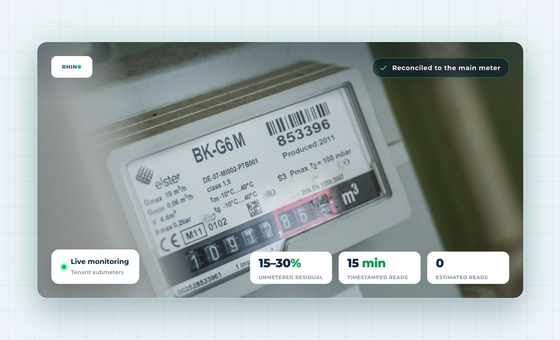
| Do this in December. | Reconcile the main meter against the sum of the submeters for the year to date. | The unmetered residual is easier to explain in December than to defend in spring. |
The last step is where most statements quietly break. The gap between the main meter and the submeters has to be allocated somewhere, and a tenant who asks what it consists of deserves an answer. How to size and explain that gap is covered in where the energy in your building actually goes.
Heating, cooling and hot water meters need one extra check this year. Under the Energy Efficiency Directive (EED), installed meters and heat cost allocators for heating, cooling and domestic hot water that cannot be read remotely must be made remotely readable or replaced by 1 January 2027, unless the member state shows this is not cost-efficient.
If you are replacing one anyway, make sure the old meter's final read and the new meter's first read are both on record.
The October list starts with knowing which tenant meters could be read without a site visit. Check your meters by make and model in the meter compatibility checker.
What changes when the meters read themselves?
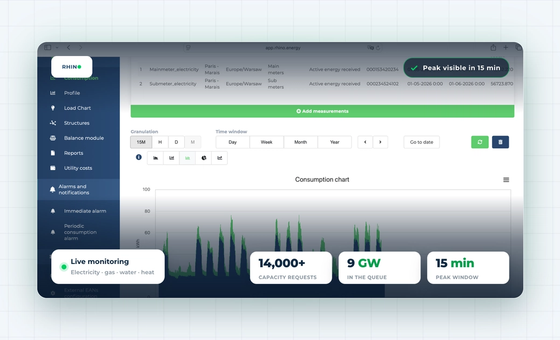
Automated reading turns the closing read from a task into a record. Rhino reads every connected meter at 15-minute intervals, so a reading for 31 December exists whether or not anyone is on site. The same applies to a move-out on a Thursday afternoon or a meter swap in the middle of a week.
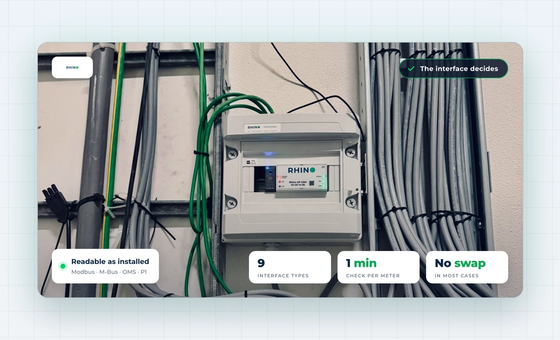
Rhino collects electricity, gas, water and heat data, including submeters, through software connections to existing smart meters, or with Rhino hardware where a meter needs it. Each meter is assigned to a tenant in the platform, so the meter to unit register sits next to the data instead of in a separate spreadsheet.
Per-tenant, per-meter readings go to the billing system you already use, including Yardi. Structure Visualization shows the main meter against every submeter and surfaces the not-submetered residual as its own figure. Rhino does not write the statement. It is not a billing platform. It is the data layer that feeds the one you have.
When are manual readings good enough?
Manual readings are fine for a building where little changes. A single-let building on a full repairing and insuring lease has nothing to apportion. A small multi-let building with a handful of meters, stable tenants and someone reliable on site on 31 December can produce a defensible statement from a dated photo of each register.
Automation has a limit worth stating too. It starts the day a meter is connected. It does not recover a year that was never recorded, which is the argument for connecting in October or November rather than expecting a February connection to fix this year's statement.
Frequently asked questions
When does the year-end service charge statement have to go out?
It depends on the country and the lease. In the UK, the RICS standard for commercial property requires year-end accounts within four months of the service charge year end. Dutch residential landlords have six months after the calendar year under article 7:259 of the Burgerlijk Wetboek, and German residential landlords twelve months under section 556 of the BGB. Other commercial leases set their own deadline.
Can I estimate a missing 31 December meter reading?
You can, but the estimate becomes the weakest line in the statement. A read taken after 31 December includes consumption from the new year, so the gap has to be split pro rata or by estimate, and the tenant can challenge that split. A dated reading taken on 31 December itself, by hand or automatically, removes the question.
What meter readings do I need when a tenant moves out?
You need a reading of every meter serving the unit on the day the lease ends, plus an opening read for the next occupier. Once a new tenant or a fit-out contractor starts using the space, consumption mixes on the same register and cannot be separated afterwards. Record which meter serves which unit at the same time.
Is it too late to install submeters in November?
No, but a submeter installed in November does not fix this year's statement, because it cannot record the months before it was connected. What it does give you is a clean opening read on 1 January and a full year of measured consumption for next year's recharge. That is the reason to install it before year end rather than after.
The statement your tenants read in spring is built from data that exists by 31 December, or not at all. Use October to check the register, November to schedule every read, and December to take them. See how Rhino delivers per-tenant meter readings to your billing workflow.