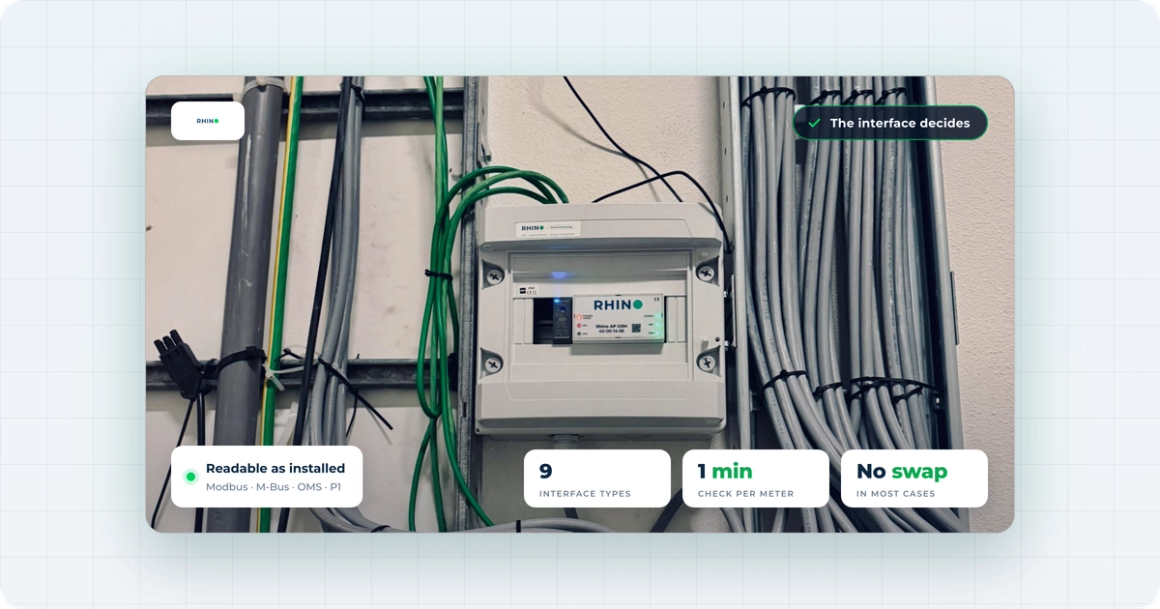
Most meters already installed in your building can be read remotely, including meters that are fifteen years old. The deciding factor is not the age of the meter or the brand on the front. It is the communication interface on the back.
That catches people out, because the common assumption is that remote reading means ripping out meters and installing new ones. It rarely does.
This post covers what remote reading actually requires, how to check a meter yourself in about a minute, which interfaces work, and the cases where a site visit is still the honest answer.
What does it mean for a meter to be read remotely?
A meter can be read remotely when it has a communication interface that passes its register values to something outside the meter, without a person standing in front of it. That interface is either a physical port or a radio transmitter: a terminal block, an optical lens, a pulse output, or an 868 MHz radio.
A display you can photograph is not an interface. A meter with an interface can be connected to a monitoring platform. A meter without one needs an adapter, or replacement.
The interface decides the answer, not the model number
Start with the interface, not the model. If a meter speaks Modbus or Meter-Bus (M-Bus), it can be read, whether or not the model appears on anybody's supported list.
This matters because of how people usually approach the question. You search for your model number, find nothing, and read that as a no. It is not a no. Rhino has 234 make and model combinations configured across 54 manufacturers as of 25 August 2026 and adds more continuously, but that list records what has already been set up. It is not the boundary of what can be read.
So when a model lookup fails, the next question is never what else you can tell someone about the model. It is what interface the meter has. That question resolves most unknown meters to a firm yes.
How to check a meter in four steps
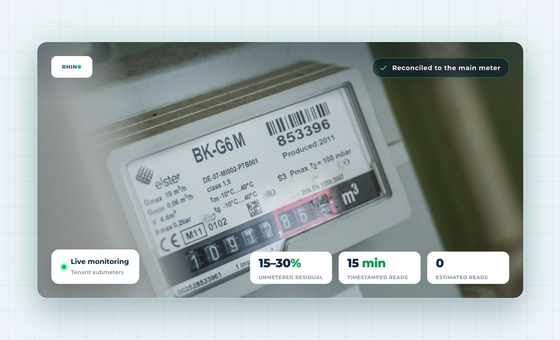
Photograph the nameplate straight on. Not at an angle, and close enough to read the small print. The nameplate carries the manufacturer, the model, the unit (kWh, m3 or GJ, which tells you the utility) and usually the protocol.
Look for protocol markings. Words such as M-Bus, Modbus, OMS, DLMS or P1 printed on the nameplate or beside a terminal answer the question on their own.
Look at the terminals and ports. A two wire terminal block, a round recessed lens, an RJ45 socket or a pair of small terminals marked S0 each point to a specific interface. The table below tells you which.
Check the model against a compatibility list. Rhino's meter compatibility checker covers the configured models and lets you browse by protocol. A match confirms it. No match sends you back to step two, which is the more reliable signal anyway.
Which interfaces can be read, and what they look like
| Which interface is it? | Where do you see it on the meter? | What does it mean for remote reading? |
|---|---|---|
| The interface is RS485 running the Modbus RTU protocol. | You see a two or three wire terminal block, usually labeled A, B and sometimes GND. | The meter is read directly over a wired bus. This is the most common interface on commercial submeters. |
| The interface is wired Meter-Bus (M-Bus). | You see a two wire terminal block marked M-Bus, and polarity does not matter. | The meter is read directly, either at the collection point or through a converter. |
| The interface is wireless M-Bus on 868 MHz, following the Open Metering System (OMS) standard. | You see no port at all. The nameplate carries an OMS or wireless M-Bus marking. | The meter broadcasts over radio and a receiver in the building picks it up, so no cabling runs to the meter. |
| The interface is a pulse output, also written S0 or Impuls. | You see two small terminals marked S0, or a pulse symbol. | Each pulse represents a fixed amount of energy or volume, so the reading is built up by counting pulses over time. |
| The interface is an optical head to IEC 62056-21, formerly numbered IEC 1107. | You see a round recessed lens on the front face of the meter. | A magnetic head clips over the lens and reads the meter through light. This is common on older utility billing meters. |
| The interface is Ethernet running Modbus TCP or BACnet. | You see an RJ45 socket. | The meter is read over the building network, so no new cable run is needed. |
| The interface is Device Language Message Specification (DLMS). | You usually see this on utility owned billing meters, often alongside an optical port. | The meter is read where access is permitted. Utility owned meters sometimes need the utility to open that access first. |
| The interface is the P1 port found on Dutch smart meters. | You see an RJ12 socket behind a small flap, marked P1. | The building occupant owns this port and can use it without involving the grid operator. |
| The interface is GazModem, used on Polish gas volume correctors. | You see an RS485 or RS232 terminal on the corrector, not on the gas meter itself. | The corrector is read rather than the meter, and it reports the temperature corrected volume. |
What if the meter has no interface at all?
Fit an adapter. Older mechanical gas and water meters frequently have no port of any kind, and the fix is a retrofit module that clamps onto or screws into the meter body and produces either a pulse or an OMS radio signal.
The common ones are the Itron Cyble Sensor for Itron gas and water meters, the IN-Z61 for Elster, Honeywell and Intergaz BK-G gas meters, the Apator AT and APT series, and the BMeters IWM series. An adapter costs a fraction of a meter replacement and does not interrupt supply.
Be aware of the limit here. Some meters have no retrofit path, usually because the manufacturer never made one or the meter is too old to have a compatible mounting. In those cases replacement genuinely is the answer, and anyone telling you otherwise is selling you something.
Electricity meters carry one extra question: current transformers
Check whether the current transformers are already installed. Semi-indirect and indirect electricity meters do not measure current directly. They measure it through current transformers (CTs) clamped around the cable, and the meter does nothing without them.
Directly connected meters, generally up to around 125 A, need no CTs. Above that they are mandatory. If they are not already in place, the installation scope and the cost both change, so this is worth establishing before anyone quotes you a number.
One more electricity question worth asking early: if the readings will be used to recharge tenants, the meter needs Measuring Instruments Directive (MID) certification. A non-certified meter can track consumption perfectly well, but it cannot carry a defensible invoice. That distinction sits behind a large share of the disputes tenants raise about their utility recharge.
Some buildings skip the hardware question entirely
Where the grid operator or metering company offers data access, the main meter is read through a software connection with no hardware on site at all. In the Netherlands that covers EDSN, Kenter, Fudura and Joulz among others, and the list of utility connectors by country keeps growing.
The honest limit: connectors reach the main meter. They do not reach your submeters. A portfolio that needs data at tenant or system level will still need something in the building, so most sites end up using both routes.
Where a compatibility yes is not yet an installation yes
Compatibility and feasibility are two separate questions, and a yes to the first does not settle the second. Three things decide the second.
Radio range. Wireless M-Bus reaches roughly 300 meters line of sight, and that figure drops sharply through floors and concrete cores. Tall buildings often need a repeater per level.
Physical access. The meter cabinet has to be openable, and there has to be free DIN rail space beside the meter for anything that mounts next to it.
Power. The collection point needs a supply where it sits. That is usually trivial and occasionally the hardest part of the whole job.
None of these change whether a meter can be read. They change how long the installation takes. A site survey answers them in an afternoon.
What this looks like once it is running
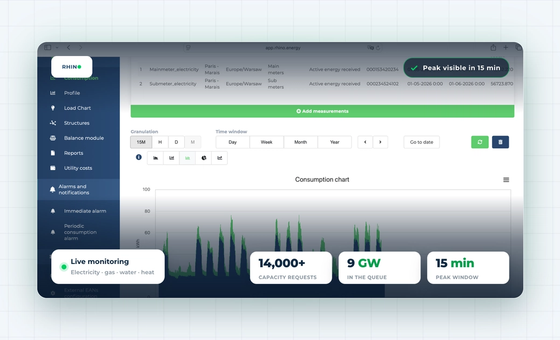
Once the interfaces are known, the rest is straightforward. Rhino reads all utilities, electricity, gas, water and heat, including submeters, at 15-minute granularity from the first day of operation. Each site gets one collection point, plus a small device per meter group chosen by interface: one for Modbus, one for pulse outputs, one for wireless M-Bus, and so on.
Rhino is the data layer between your meters and whatever you already use for reporting, billing or tenant engagement. It sits alongside a building management system rather than replacing it, and it connects to infrastructure already in the building, which is what keeps the capital cost low.
Frequently asked questions
Can an old meter be read remotely?
Usually yes. Age matters far less than the interface. Meters from the early 2010s routinely carry Modbus, M-Bus or a pulse output, all of which are readable. Mechanical gas and water meters with no port at all can often take a retrofit adapter that produces a pulse or a radio signal, so even those are frequently readable without replacement.
Do I need to replace my meters to get remote readings?
Rarely. Replacement is the last option, not the first. Most commercial meters already have a communication interface that has simply never been connected to anything. Where no interface exists, an adapter fitted to the existing meter is normally cheaper and faster than a new meter, and it does not interrupt supply.
How do I find out which protocol my meter uses?
Read the nameplate. Protocol markings such as M-Bus, Modbus, OMS, DLMS or P1 are printed on the nameplate or next to the relevant terminal. If nothing is printed, the terminals identify it: a two wire block marked M-Bus, an A and B pair for RS485, an RJ45 socket for Ethernet, or two small terminals marked S0 for a pulse output.
Can gas and water meters be read remotely too?
Yes. Gas and water meters are read through a pulse output, through wireless M-Bus, or through a retrofit adapter such as the Itron Cyble Sensor or the Apator AT series. Heat meters usually carry M-Bus or wireless M-Bus as standard. All utilities can be collected into one dataset alongside electricity.
Start with the interfaces you already have
The practical move is not to plan a meter replacement program. It is to walk the meter rooms, photograph the nameplates, and sort them by interface. Most portfolios find that the large majority of their meters were already readable and nobody had checked.
If you want that check run across a portfolio rather than a building, see how Rhino builds a single view across a mixed portfolio.