Most commercial buildings still run on a single main meter. It records the total and nothing else: no split by tenant, no split by system, no way to see where the cost actually came from. Submetering fills that gap by measuring consumption at the level that matters, per tenant, per floor, per piece of equipment. Below are the five benefits that make it worth doing.
What is utility submetering?
Utility submetering is the practice of installing meters downstream of the main utility meter to measure the consumption of individual tenants, floors, zones, or equipment. The main meter shows the total for the whole building. Submeters break that total down into its parts. A building might have one electricity connection from the grid and twenty submeters behind it, one per tenant unit, so each unit's use can be measured on its own. The same applies to gas, water, and heat.
1. Fair, accurate tenant billing
Submetering lets you bill each tenant for what they actually used, not for a share estimated from floor area. Splitting a building's utility bill by square meters is simple, but it is almost always wrong: a data room, a restaurant kitchen, or a tenant running two shifts consumes far more per square meter than a quiet office next door. Submeter data removes the estimate and the argument that comes with it. Tenants pay their real usage, and the disputes that come from guesswork disappear.
2. Lower cost, because you can see where it goes
You cannot cut a cost you cannot see. A main meter tells you the building spent more this month, but not which tenant, floor, or system caused it. Submeters show consumption load by load, so you can find the waste: the equipment left running after hours, the common-area system with no schedule, or the unit that quietly doubled its use. Once the waste is visible, it is fixable. This is usually the cheapest saving in the building.
3. Faster fault and anomaly detection
With submeters in place, a change in consumption points to a specific meter, not a whole building. A pump that starts running overnight, a cooling system stuck on, a water line leaking behind a wall: each shows up as a rise on one submeter while the others stay flat. That turns a vague, building-wide bill increase into a single location you can send someone to check. Problems get caught in days rather than at year-end.
4. Better data for operations and ESG decisions
Submeter data shows how each part of the building actually behaves, which is the input every serious decision needs. Facility teams use it to tune HVAC and BMS schedules against real load rather than assumptions. Asset managers use it to decide whether a retrofit pays back, because they can see exactly what a system costs to run before and after. And ESG reporting under CSRD and EPBD increasingly expects consumption evidence at a level a single main meter cannot provide.
5. Compliance and sustainability
Submetering is moving from good practice to legal requirement in parts of Europe. The EU Energy Efficiency Directive (EED) already mandates individual metering and billing in many building types where it is technically feasible and cost-effective, and requires heat, cooling, and hot water meters to be remotely readable, with all such meters remotely readable by 1 January 2027. Beyond compliance, submetering is the first step to using less: once you can see which parts of a building consume the most, you can target reductions where they actually move the number. Understanding consumption is where every sustainability gain starts.
How to add submetering without rewiring the building
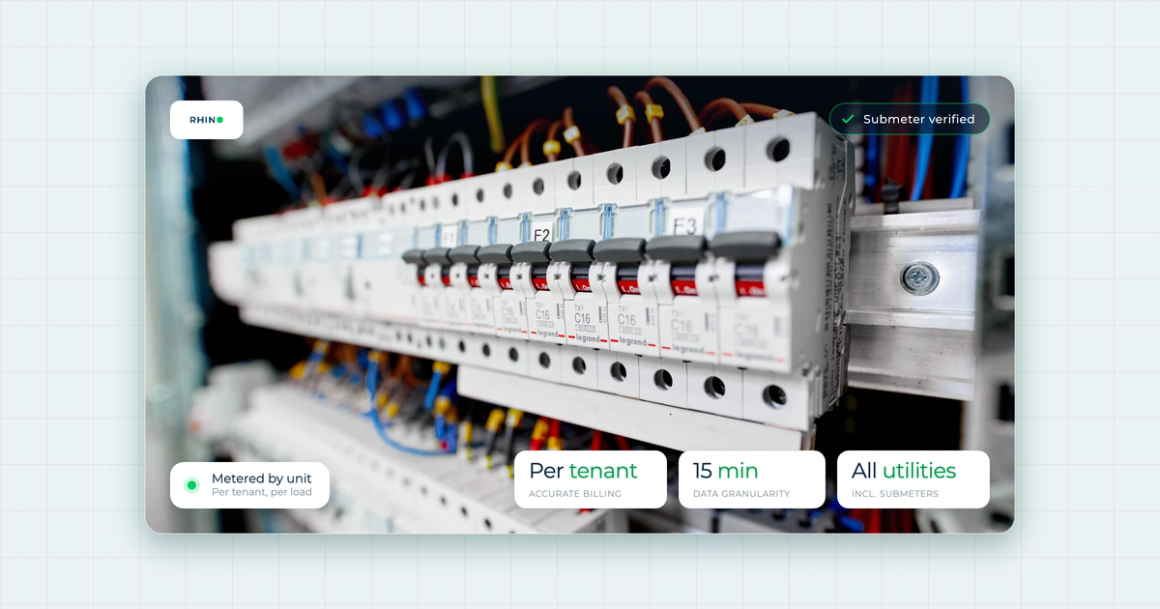
The old objection to submetering was cost: pulling new meters and cabling through an occupied building is disruptive and expensive. That is no longer the only route. Many buildings already have submeters, or meters with a digital output, that were never connected to anything. Rhino reads utility data through whichever path a building already has: a direct cloud connection to the utility or metering provider, the existing BMS or gateway on site, or Rhino hardware on meters that have no digital output yet. All utilities, electricity, gas, water, and heat, including submeters, land in one place at 15-minute granularity. No infrastructure overhaul, and low CAPEX from day one. See how submeter data turns into accurate tenant billing.
Frequently asked questions
What is the difference between a meter and a submeter?
The main meter measures the total utility consumption entering a building and is the one the utility bills against. A submeter sits behind it and measures the consumption of one part of the building: a single tenant, floor, or piece of equipment. Submeters are not used for the utility's own billing. They exist so the building owner can break the total down.
Is submetering required by law?
In the EU, the Energy Efficiency Directive (EED) requires individual metering and billing in many multi-tenant building types where it is technically feasible and cost-effective, and requires heat, cooling, and hot water meters to be remotely readable, with all such meters remotely readable by 1 January 2027. Requirements vary by country and building type, so check the rules for your market.
What utilities can be submetered?
Electricity, gas, water, and heat can all be submetered. In commercial real estate, electricity and heat are the most common, but water and gas submetering matter for cost recovery and leak detection too.
Do you need to rewire a building to install submetering?
Not always. Many buildings already have submeters, or meters with a digital output, that were never connected to a monitoring platform. Where a meter has no digital output, a small device can be added to read it. Reading the meters a building already has avoids the cost and disruption of a full rewiring project.
How does submetering reduce energy costs?
Submetering makes waste visible. A main meter only shows the building total, so a system left running or a unit consuming far more than it should stays hidden in the sum. Submeter data isolates each load, so the waste can be found and fixed, and tenants can be billed for their own use rather than the landlord absorbing it.
Submetering turns one number you cannot act on into a picture you can. That is what makes fair billing, real cost control, and defensible compliance data possible. The buildings that get there are the ones that stop guessing and start measuring.
Before any of this is a project, it is a question about the meters already on site. Name one in the meter compatibility checker and you get a straight answer, with no signup.