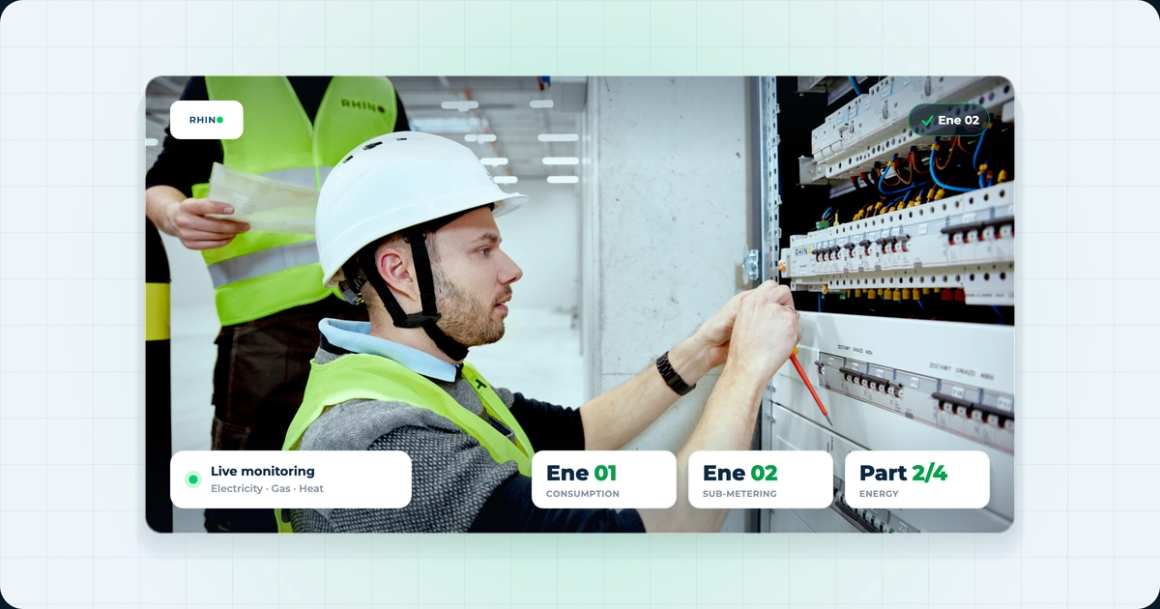
Energy is the highest-weighted category in BREEAM, and it is where metered data does the most work. Submetering, operational consumption and reporting credits are earned or directly evidenced by continuous energy data. This post breaks down which energy credits that is, in both BREEAM In-Use International Commercial Version 6 and New Construction Version 7.
This is a four-part series: Part 1: a practical guide, Part 2: energy credits, Part 3: water credits and Part 4: management credits.
The energy credits utility data earns, at a glance
| Credit | Scheme | What it rewards | Data's role |
|---|---|---|---|
| Ene 15 Monitoring energy uses | In-Use V6 (Asset) | Submetering of significant energy uses | Earns it: hardware submeters |
| Ene 16 Monitoring tenanted areas | In-Use V6 (Asset) | Separate metering of tenanted spaces | Earns it: tenant-level submetering |
| Ene 19 to 21 Operational energy | In-Use V6 (Management) | Actual fuel, district heat and on-site renewable data | Earns it: supplies the numbers |
| Ene 23 Energy consumption reporting | In-Use V6 (Management) | Measuring against targets and reporting | Earns it: automated reporting |
| Ene 22 Energy audit | In-Use V6 (Management) | A recent building-specific energy audit | Evidences it: feeds the audit |
| Ene 03 Energy monitoring | New Construction V7 | Designed-in submetering by end use | Earns it: installs and operationalises submeters |
| Ene 02 Operational energy prediction | New Construction V7 | Modelled in-use energy and carbon | Supports it: benchmark and verification data |
BREEAM In-Use V6: the energy credits that run on data
Ene 15 Monitoring energy uses, and Ene 16 Monitoring tenanted areas
These are the clearest fit for a monitoring platform, and they sit in Part 1 (Asset Performance). Ene 15 rewards submetering the building's significant energy uses so consumption can be broken down by system and area rather than read from a single main meter. Ene 16 rewards metering tenanted areas separately, so landlord and tenant consumption can be told apart.
Two things to know. First, these credits require hardware submeters. Non-intrusive load monitoring (NILM), which estimates end-use from a single meter in software, is not accepted. Rhino reads physical meters and submeters, so it qualifies. Second, this is the layer everything else depends on: without submetering, the operational and reporting credits below have nothing to report.
Ene 19 to Ene 21: operational energy
Part 2 (Management Performance) needs at least 12 months of real consumption data. Ene 19 accounts for the asset's actual metered energy (electricity, gas and other fuels). Ene 20 accounts for the carbon intensity of any district heating or cooling. Ene 21 accounts for on-site renewable electricity generated and used. All three are earned by supplying accurate, complete data for a consistent 12-month period, which is exactly what an automated platform produces without the month-end scramble across spreadsheets.
Ene 22 Energy audit, and Ene 23 Energy consumption reporting
Ene 22 rewards a recent, building-specific energy audit (typically no more than four years old, ideally to ISO 50002), with more credits for implementing its recommendations. The audit itself is a consultant deliverable, but it runs on metered data and load profiles, so good submetering makes it faster and cheaper.
Ene 23 is earned outright by data practice: collect consumption data, compare it against a target, and report it. More credits follow for reporting internally, then publicly. Automated reporting is the deliverable here, not a manual spreadsheet exercise.
Ene 24 Reduction of carbon emissions
Ene 24 is an exemplary credit that rewards a demonstrated year-on-year fall in the asset's carbon emissions, measured across three years. The reduction itself comes from operational and plant improvements, but you can only prove it with a consistent, multi-year record of consumption data. That record is a direct output of continuous monitoring.
The In-Use pattern: submeter the building (Ene 15 and 16), supply 12 months of clean operational data (Ene 19 to 21), measure against targets and report (Ene 23), then prove the trend over time (Ene 24). That is a monitoring platform's job description.
See how Rhino submeters a whole portfolio and reports it automatically.
BREEAM New Construction V7: design the data in
New Construction is a design-stage scheme, so the goal is to build in the metering and the low-energy design that operation will later rely on. Note the V7 renumbering.
Ene 03 Energy monitoring (was Ene 02 in V6)
This is the credit that used to be Ene 02. It rewards designing in submetering by end use and major system, with outputs that connect to a monitoring system or BMS, so at least the large majority of energy consumption is measurable once the building is occupied. Specifying meters that a platform like Rhino can read from day one is what turns this design credit into working operational data later.
Ene 02 Operational energy prediction, and Ene 01
The headline V7 change is Ene 02, now operational energy prediction: modelled in-use energy and carbon, benchmarked against energy-use-intensity targets, with roughly three times the credits of the old approach and extra credit for third-party verification. This is primarily a modelling credit, but metered data from comparable operational assets, and post-occupancy verification, both strengthen it. Ene 01 (regulated energy and carbon performance) remains a design and fabric credit that data supports rather than earns.
V7 also added credits for flexible demand response (Ene 07) and installed controls (Ene 08). These are physical capabilities. Monitoring shows they are working, but installing them earns the credit.
The energy credits utility data does not earn
Building fabric and envelope performance, HVAC and lighting efficiency, on-site generation hardware, controls and demand-response capability. Data verifies that these perform once in place. It does not earn the credit.
Frequently asked questions
What is the difference between BREEAM Ene 02 and Ene 03?
It depends on the scheme version. In New Construction V6, Ene 02 was Energy Monitoring. In V7, Ene 02 became operational energy prediction, and energy monitoring was renumbered to Ene 03. In-Use uses different codes again (Ene 15 and Ene 16 for monitoring).
Which BREEAM In-Use credit covers submetering?
Ene 15 (Monitoring energy uses) and Ene 16 (Monitoring tenanted areas), both in Part 1 Asset Performance. They require hardware submeters; NILM is not accepted.
Does BREEAM accept virtual or NILM submetering?
Not for the In-Use monitoring credits. Those require physical submeters. A platform that reads real meters, like Rhino, qualifies; software-only estimation does not.
How much energy data does BREEAM In-Use need?
Part 2 (Management Performance) credits need at least 12 months of consistent, metered consumption data covering all fuels and the assessed floor area.