The Energy Performance of Buildings Directive (EPBD) is the EU's main law for making buildings more efficient, and its 2024 recast, Directive (EU) 2024/1275, is the most far-reaching version yet. It entered into force on 28 May 2024, and every member state must have it in national law by 29 May 2026. For owners of commercial real estate, this is the framework that will shape renovation obligations, energy labels and reporting for the rest of the decade.
The detail lands in national law, so exact thresholds differ per country. But the direction is fixed and the deadlines are close. Here is what the recast asks of commercial portfolios, and why accurate energy data is the part you can start on today.
What the recast actually is
The EPBD sets binding targets for the energy performance of buildings across all 27 member states. Each country translates it into its own rules, such as the Dutch GACS obligation or national energy-label requirements. The 2024 recast raises the bar on existing buildings, tightens the rules for new ones, and moves continuous monitoring and automation into the mainstream.
What it means for commercial real estate
The recast is a set of interlocking requirements. These are the ones that matter most for a portfolio:
- Minimum energy performance standards (MEPS): national standards that force renovation of the worst-performing non-residential stock. Across the EU, the worst 16% must be improved by 2030 and the worst 26% by 2033. If an asset sits in that bottom band, renovation is not optional.
- Zero-emission new buildings (ZEB): new buildings owned by public bodies must be zero-emission from 2028, all other new buildings from 2030. ZEB replaces the near-zero (BENG-style) standard.
- Solar mandates: solar installations become mandatory on new non-residential and public buildings, and on existing non-residential buildings above 500 m² undergoing major renovation, where technically and economically feasible, phased in between 2026 and 2030.
- Building automation and control (BACS): the recast lowers the threshold for mandatory building automation and control systems from 290 kW to 70 kW of heating or cooling capacity by 2030. In the Netherlands this is the GACS obligation.
- Whole-life carbon: the global warming potential of large new buildings must be calculated and disclosed on the Energy Performance Certificate from 2028, and for all new buildings from 2030.
- Rescaled energy labels: EPCs move to a harmonised A to G scale, with class A reserved for zero-emission buildings. Many assets will see their label shift.
- Fossil-fuel heating phase-out: subsidies for stand-alone fossil-fuel boilers ended in 2025, with a full phase-out targeted for 2040.
The deadlines that matter
The dates are close enough to plan around now:
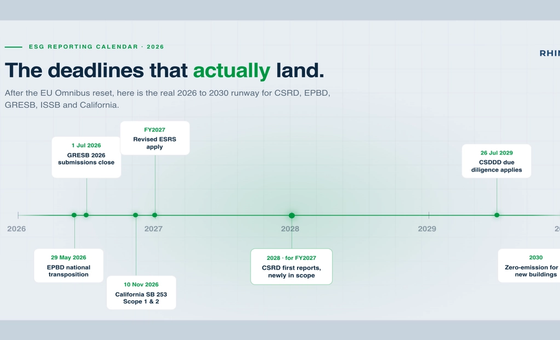
- 29 May 2026: national transposition deadline. From here the rules are live in each country.
- 2026 to 2030: solar mandates phase in for new and renovated non-residential buildings.
- 2028: zero-emission standard for new public buildings; whole-life carbon disclosure for large new builds.
- 2030: worst 16% of non-residential stock improved; zero-emission standard for all new buildings; BACS threshold down to 70 kW.
- 2033: worst 26% of non-residential stock improved.
- 2040: fossil-fuel boilers phased out.
Why this starts with data
Almost every one of these obligations depends on knowing what your buildings actually consume. You cannot prove a building has moved out of the worst-performing band, size a renovation, or produce an accurate EPC without reliable, granular consumption data. The recast makes that explicit: it expands building automation and monitoring, and ties public funding and labels to measured performance. The owners who move fastest will be the ones whose data is already in order.
Want the full breakdown of the directive and how it maps to your portfolio? See our EPBD overview.
Where to start
- Map your portfolio against the thresholds: which assets are likely in the worst-performing band, and which cross the BACS capacity line.
- Get a reliable consumption baseline per building and per utility. You cannot manage what you cannot measure.
- Prioritise renovations by data, not assumptions: let actual consumption show where the waste is.
- Connect the data once and use it everywhere: the same measured data feeds EPCs, MEPS evidence, CSRD reporting and BACS.
How Rhino fits
Rhino sits at the data layer. We collect and automate your utility data, electricity, gas, water and heat, down to submeter level, across your portfolio. Via a software connection to smart meters, or with our own compact hardware next to meters that don't yet communicate digitally. That gives you the accurate, complete consumption record every EPBD obligation leans on: continuous monitoring, anomaly alerts, exportable history for audits, and periodic reporting.
The renovation and control work sits with your installers and BMS partner. The data foundation underneath sits with us. And because Rhino connects to existing infrastructure, the CAPEX stays low: no meter replacements, no separate gateway.
How the EPBD applies to a specific building depends on your national implementation, so confirm the detail with your energy advisor. What is certain: it all rests on data that is accurate and complete, which is exactly what we deliver. Ready to get your utility data in order? Talk to Sales, or read the full EPBD overview. For related obligations, see our guides to GACS and CSRD.
Frequently asked questions about the EPBD
What is the EPBD recast?
The EPBD recast is Directive (EU) 2024/1275, the 2024 revision of the EU's Energy Performance of Buildings Directive. It tightens energy performance rules for new and existing buildings, introduces minimum energy performance standards for the worst-performing stock, and expands building automation, solar and whole-life carbon requirements.
When does the EPBD 2024 take effect?
It entered into force on 28 May 2024. Member states must transpose it into national law by 29 May 2026, after which the obligations apply through country-specific rules, with milestone dates in 2028, 2030, 2033 and 2040.
What does the EPBD mean for existing commercial buildings?
Existing non-residential buildings face minimum energy performance standards that trigger renovation of the worst performers: the worst 16% by 2030 and the worst 26% by 2033. Energy labels are also rescaled, and building automation becomes mandatory above 70 kW by 2030.
Does the EPBD require building automation?
Yes. The recast lowers the threshold for mandatory building automation and control systems to 70 kW of heating or cooling capacity by 2030. In the Netherlands this is implemented as the GACS obligation, already in force above 290 kW since 2026.
How does Rhino help with EPBD compliance?
Rhino delivers the data layer the directive depends on: continuous monitoring of electricity, gas, water and heat down to submeter level, anomaly alerts, exportable history and periodic reporting. That same data supports EPCs, MEPS evidence, BACS and CSRD from one source. The renovation and control work stays with your installer.