A commercial energy bill is a claim about how much you used and what it cost. Like any claim, it can be checked, and it can be wrong. Estimated reads, misapplied capacity charges, and stale tariffs all push bills in one direction, and it is not yours. With your own interval data, you can verify the bill line by line and challenge what does not add up.
Can you dispute a commercial energy bill?
Yes. If you have independent meter data, you can compare it against what the supplier billed and raise a formal query on any discrepancy. The catch is evidence. A supplier will not reverse a charge because a bill "looks high". They will reverse it when you show your own reading for the same meter and the same period, and the two do not match.
What to check on a commercial energy bill
Consumption against your own meter
The first check is the simplest. Take the consumption the supplier billed for the period and compare it to your own meter reading for the same period. If the supplier used an estimate, this is where estimates and reality part ways.
Estimated versus actual reads
Look for an "E" or the word estimated next to the reading. Estimated bills are the single most common source of overcharging, because an estimate based on a busy month applied to a quiet one bills you for consumption that never happened. Actual reads, ideally from your own interval data, remove the guess.
Capacity and peak demand charges
Commercial tariffs often bill a capacity or peak demand component based on the highest power draw in the period, not just total energy. If your contracted capacity is set higher than you actually use, you are paying for headroom you never touch. Your load profile shows your real peak, which tells you whether the contracted level, and the charge, is right.
Standing charges, tariffs and tax
Confirm the standing charge, the unit rate, and any tax or levy match your contract. Rates roll over, contracts get renewed on default terms, and a tariff that changed without you noticing shows up here.
How interval data proves an overcharge
A monthly total gives you one number to argue with. Interval data gives you the whole shape of the month: every 15 minutes, what the meter actually drew. That turns a dispute from opinion into record. You can show the supplier the exact reading at the exact time, demonstrate that a billed peak never occurred, or prove a meter was flat during a period they billed as active. It is much harder to wave away a timestamped reading than a gut feeling that the bill seems high.
You can see how Rhino turns meter data into recovered cost on the cost reduction page.
A simple process to check every bill
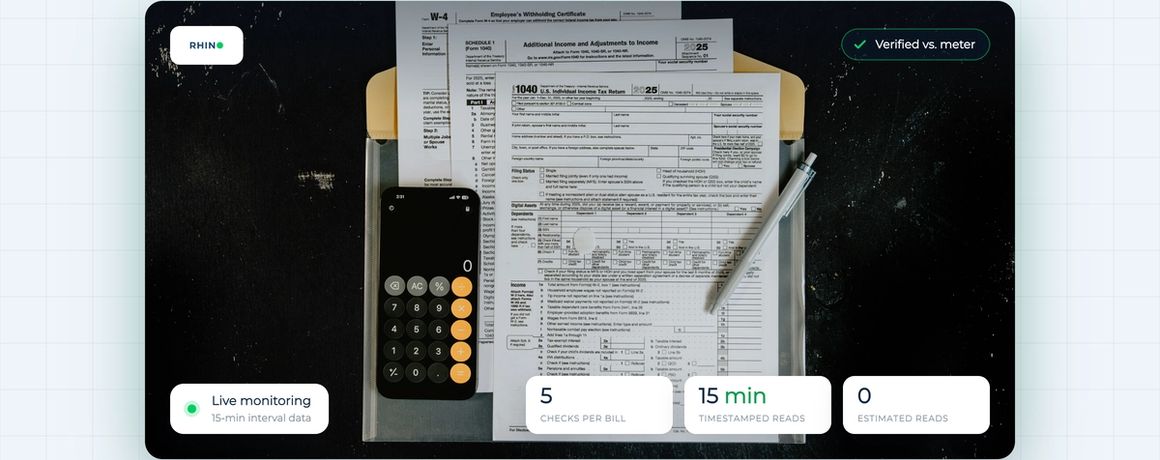
Do the same five things each cycle. Match billed consumption to your own reading for the period. Check whether the read was actual or estimated. Compare your real peak against the capacity you are billed for. Confirm the standing charge and unit rate against the contract. Then query anything that does not reconcile, with your data attached.
The point is not to catch the supplier out once. It is to make the check routine, so an error gets caught in the month it happens instead of a year later when it is buried in twelve bills.