
California benchmarking law
California AB 802: benchmark by June 1.
AB 802 requires owners of California buildings over 50,000 sq ft to benchmark their energy use in ENERGY STAR Portfolio Manager and report it to the California Energy Commission every June 1. Only about half do, and the Commission says it will step up enforcement. A statewide performance standard is the next step it has proposed.
What AB 802 requires
A yearly benchmark for about 50,000 buildings.
The California Energy Commission runs the Building Energy Benchmarking Program created by AB 802 in 2015. It covers nearly 50,000 buildings, roughly 60% of the state's floor area, and the results are public.
Who is covered
Buildings over 50,000 sq ft with no residential utility accounts, or with 17 or more. That includes offices, retail, warehouses, historic and non-federal government buildings. Condos and buildings mainly used for manufacturing, industry or labs are excluded.
A report every June 1
Request utility data by March 1, enter it in ENERGY STAR Portfolio Manager, run the data checks, and submit the report to the Commission by June 1 with a Benchmarking Reference Number. There is no filing fee.
Public from year two
From a building's second reporting year, its data is published on the Commission's dashboard: the ENERGY STAR score, energy use by fuel, weather-normalized energy use intensity and total greenhouse gas emissions.
Data, penalties and local laws
Utilities must share the data. Owners must report it.
AB 802 puts obligations on both sides. Utilities have to hand over whole-building data on request, and owners who do not report face daily penalties.
Whole-building data from utilities
On request, utilities provide aggregated monthly data for the whole building, for at least the prior calendar year, within 28 days of a complete request. With three or more accounts, no tenant permission is needed. Some upload straight into Portfolio Manager.
Up to $2,000 a day
After notice and 30 days to correct, the Commission can fine up to $2,000 a day for each category of missing data, with no cap. Compliance is around 50%, and the Commission is contacting owners who missed earlier years.
Seven cities report locally
Buildings in Berkeley, Brisbane, Chula Vista, Los Angeles, San Diego, San Francisco and San Jose report under their city's own ordinance instead. If the city exempts a building that AB 802 covers, the owner still reports to the state.
A statewide performance standard is on the table. In a July 2026 draft report, the Energy Commission recommended a building performance standard for the same buildings over 50,000 sq ft: five-year compliance cycles, limits on both energy use and direct emissions, verified data, and final targets in 2045. It is a recommendation, not law, and the Commission says it will likely need new legislation. San Jose already sets performance requirements, and Los Angeles requires audits and retro-commissioning every five years. Sources: California Energy Commission, Title 20 sections 1680 to 1685, and the draft Building Energy Performance Strategy Report, checked October 2026.
Rhino's role
Report this year. Be ready for the standard.
Utility data gets a building through its AB 802 report. It does not show where the energy goes, and that is what a performance standard will ask you to change. Rhino reads every meter, so you have both.
01
More than whole-building totals
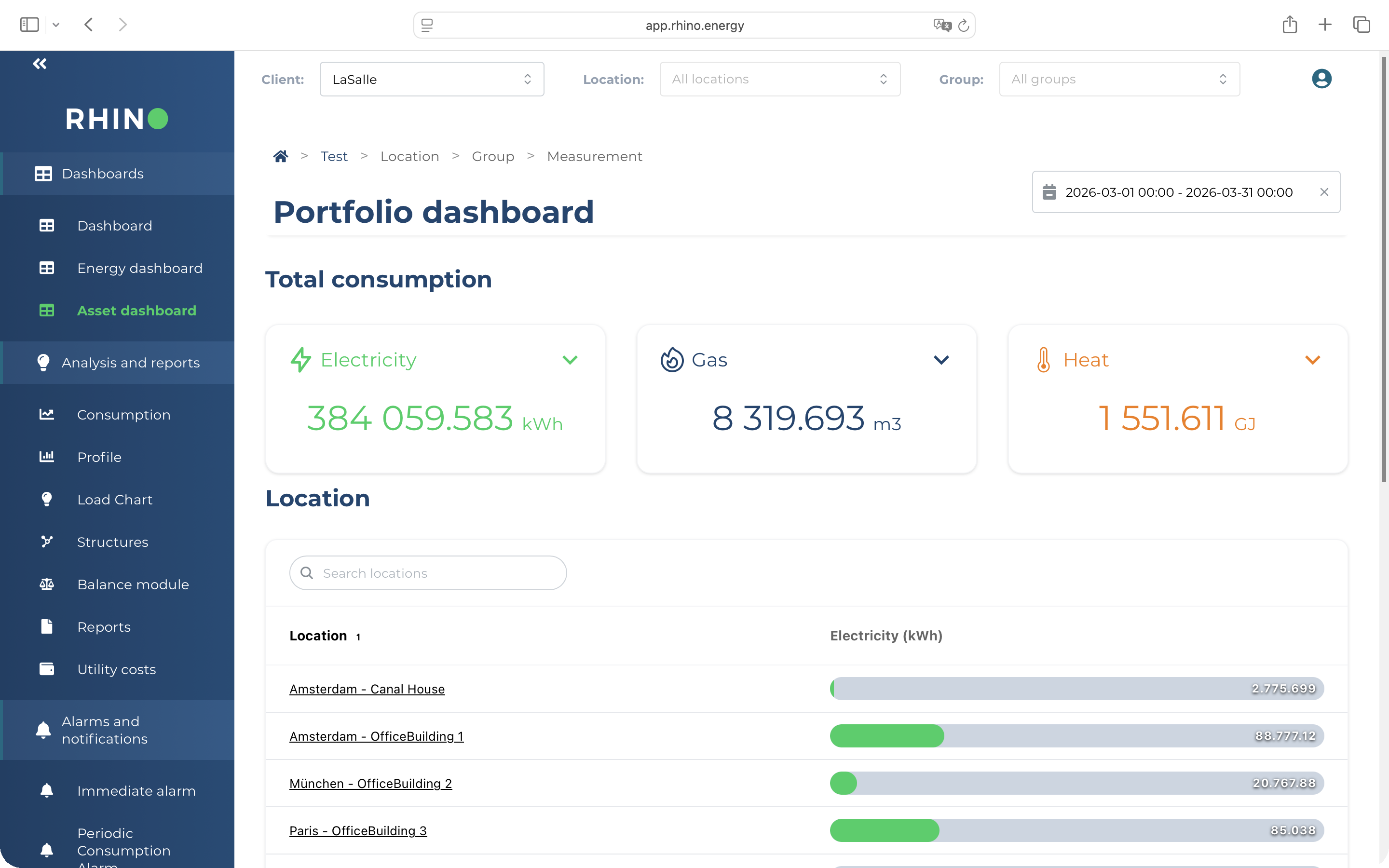
Utility data arrives as one monthly number per building and fuel. Rhino reads every meter behind it, electricity, gas, water and heat, including tenant submeters, through existing smart meters or Rhino hardware, which is FCC certified for the US.
02
Complete data for every June 1
Export monthly totals per meter for ENERGY STAR Portfolio Manager for every building in the portfolio, or send the same data to Measurabl and your own tools through the Rhino API. No March scramble for utility requests.
03
A baseline before the rules arrive
Performance standards measure against a baseline, and the draft California standard would track energy and emissions over five-year cycles. 15-minute data shows after-hours waste and runaway systems now, while cuts are still cheap.
What Rhino covers
All utilities
Electricity, gas, water, heat, including tenant submeters. Every meter, not one total per building.
15 min
Default data granularity, stored from day one. Monthly totals are built from measured intervals.
June 1
The yearly AB 802 deadline. With the data already complete, reporting starts from finished numbers.
Common questions
California AB 802, answered.
AB 802 is the 2015 California law behind the state's Building Energy Benchmarking Program, run by the California Energy Commission. It requires owners of large buildings to benchmark energy use in ENERGY STAR Portfolio Manager and report it every year, and requires utilities to give owners whole-building energy data on request. Results are publicly disclosed.
Buildings with more than 50,000 sq ft of gross floor area that have either no residential utility accounts or 17 or more of them. Commercial buildings have reported since 2018 and multifamily since 2019. Condos, buildings mainly used for manufacturing, industry or labs, and federally owned buildings are excluded.
June 1 every year. Owners should request utility data by March 1, enter it in Portfolio Manager, and submit the report through the Energy Commission's reporting link with a Benchmarking Reference Number. Utilities have 28 days to deliver data once a request is complete.
After a notice and 30 days to correct, the Energy Commission can fine up to $2,000 a day for each category of missing data, with no cap on the total. Compliance is currently around 50%, and the Commission has said it plans to increase enforcement. There is no penalty for high energy use itself.
In seven cities, yes: Berkeley, Brisbane, Chula Vista, Los Angeles, San Diego, San Francisco and San Jose have ordinances the Energy Commission accepts in place of state reporting. If a city ordinance exempts a building that AB 802 covers, the owner must still report to the state.
It has been proposed, not adopted. A July 2026 draft report from the Energy Commission recommends a statewide standard for buildings over 50,000 sq ft, with five-year cycles, energy and direct emissions metrics, verified data and final targets in 2045. The Commission says this will likely require new legislation.
Benchmark California buildings from meter data.
Rhino connects to the meters you already have and keeps a complete history for every utility, ready for June 1 and for the standard that follows.
Further reading
From the Rhino blog.

