
Boston building emissions law
Boston BERDO: emissions limits are now live.
BERDO 2.0 puts an emissions limit on Boston buildings of 35,000 sq ft or 35 units and up from 2025, and on buildings from 20,000 sq ft or 15 units from 2030. Every ton over the limit costs $234 as an alternative compliance payment. The limits step down every five years, to zero in 2050, and they count every fuel the building burns or buys.
What BERDO requires
Report every year. Verify the data. Stay under the limit.
The Building Emissions Reduction and Disclosure Ordinance covers about 5% of Boston's buildings, which together produce nearly 40% of the city's emissions. Owners report every year, have the data checked by a third party, and are held to an emissions limit per square foot.
Who is covered
Non-residential buildings of 20,000 sq ft or more, residential buildings with 15 or more units, and parcels whose buildings together pass either threshold. Each building reports and complies on its own unless it is part of an approved portfolio.
A report every May 15
Energy and water use for the previous calendar year, through ENERGY STAR Portfolio Manager plus a BERDO Reporting Form. Results are published every October, including emissions per sq ft, compliance status and the ENERGY STAR score.
Third-party verification
In the first reporting year, the first compliance year and every five years after, a qualified energy professional who is not on the owner's or manager's staff checks the data. Owners keep records for ten years.
The emissions standards
A limit per square foot that falls every five years.
Each building type has its own limit in kilograms of CO2e per square foot per year. 2026 is the first year the largest buildings are assessed, on their 2025 emissions.
2025: the largest buildings
Buildings of 35,000 sq ft or more, or 35 or more units, are held to the 2025 to 2029 limits now. Buildings from 20,000 sq ft or 15 units follow from 2030, assessed in 2031.
Office: 5.3 to 3.2 in 2030
An office building's limit drops from 5.3 kgCO2e per sq ft today to 3.2 in 2030, 2.4 in 2035, and zero in 2050. Multifamily goes from 4.1 to 2.4, retail from 7.1 to 3.4.
Every fuel counts
Electricity, natural gas, fuel oil, propane, steam, and hot and chilled water all count toward the limit. Renewable energy certificates and power purchase agreements can only offset the electricity share, never the fuel.
Over the limit costs $234 a ton. Ignoring it costs more. An alternative compliance payment of $234 per metric ton of CO2e covers the excess, and the money goes to Boston's Equitable Emissions Investment Fund. Failing to meet the standard otherwise draws fines of up to $1,000 a day for large buildings, and failing to report up to $300 a day. Portfolio, blended and individual compliance options exist, with approval from the BERDO Review Board. Sources: City of Boston, the BERDO ordinance and the 2025 and 2026 regulations, checked October 2026.
Rhino's role
Every fuel, every meter, ready for the verifier.
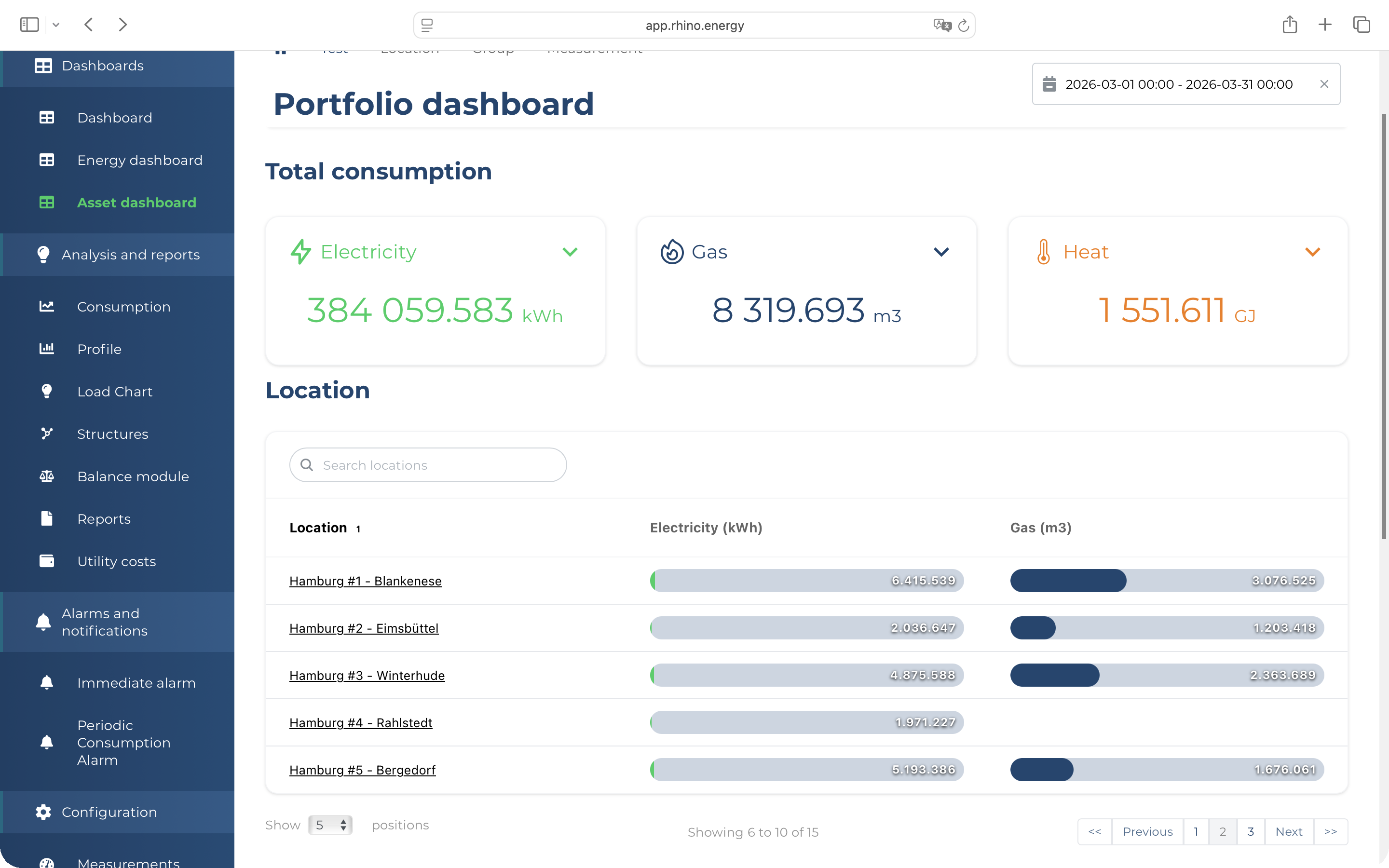
A BERDO number is only as good as the data under it. Gas and steam drive most building emissions, and they are the meters least likely to be read often. Rhino reads all of them, continuously, at building and tenant level.
01
All utilities at building level
Electricity, gas, water and heat, including steam and hot water through heat meters, read through existing smart meters or Rhino hardware, which is FCC certified for the US. See which fuel is pushing a building over its limit, month by month.
02
Tenant data without the February wait
BERDO lets owners ask tenants for their energy data in January, with replies due by February 28. Where tenant spaces are submetered, Rhino already has that consumption, every 15 minutes, assigned to the right tenant.
03
A history a verifier can trace
Every figure traces back to timestamped meter readings, kept from day one. Export monthly totals per meter for ENERGY STAR Portfolio Manager, and give your verifier the readings behind them.
What Rhino covers
All utilities
Electricity, gas, water, heat, including tenant submeters. Every fuel BERDO counts, in one platform.
15 min
Default data granularity, stored from day one. Continuous metering, not a once-a-year total.
2030
When the limits drop again, and when smaller buildings join. Five years to find the tons.
Common questions
Boston BERDO, answered.
BERDO 2.0 is the current version of Boston's Building Emissions Reduction and Disclosure Ordinance. It requires large buildings to report energy and water use every year, have that data verified by a third party, and meet emissions limits that step down every five years until they reach net zero in 2050.
Non-residential buildings of 20,000 sq ft or more, residential buildings with 15 or more units, and parcels with several buildings that together reach 20,000 sq ft or 15 units. Buildings of 35,000 sq ft or 35 units and up have been held to emissions limits since 2025. Smaller covered buildings follow from 2030.
May 15 each year, covering the previous calendar year, through ENERGY STAR Portfolio Manager and a BERDO Reporting Form. In 2026 the city extended the deadline by three months, to August 15. Third-party verification is due with the report in verification years.
Each building use type has a limit in kgCO2e per square foot per year, falling every five years. For offices it is 5.3 for 2025 to 2029, 3.2 for 2030 to 2034, 2.4 for 2035 to 2039, 1.6, then 0.8, and zero from 2050. Multifamily starts at 4.1 and retail at 7.1. Buildings with several uses can apply a blended standard.
The owner can make an alternative compliance payment of $234 per metric ton of CO2e over the limit, which counts as compliance, not a fine. A building that neither meets its limit nor pays can be fined up to $1,000 a day, or up to $300 a day for smaller buildings. Failing to report costs up to $300 a day, or $150 for smaller buildings.
Yes, but only against electricity emissions. Certificates must be Massachusetts Class I, non-emitting, tracked in NEPOOL GIS, and generated and retired within set windows around the compliance year. Qualifying power purchase agreements, on-site solar in Boston and Boston Community Choice Electricity also count. Emissions from gas, oil and steam cannot be offset this way.
See which fuel is putting your building over the limit.
Rhino connects to the meters in your Boston buildings, gas and steam included, and shows consumption for every utility every 15 minutes.
Further reading
From the Rhino blog.

